

Location: Australia
I find reward in following my creative desires and in the belief that if I apply my art work effectively I may expose, challenge and draw attention to the unique qualities of nature and/or urgent environmental situations we are facing today.
I firmly believe that art and creative intent has the power to raise environmental awareness, where the sciences too often fail. The creative endeavour can engage with a wider audience in a non threatening manner and if successful, the message can connect on an emotional level.
This set of photos provide an insight into part of my local landscape, a unique environment and where I have often draw my inspiration and subject matter to create my art. Ultimately I am motivated and have a passion for this unique place and seek to create works that highlight its ever changing state and similar fragile environments within my local area.
Often called the Bronze Ibis by locals this migratory species comes to the Gwydir Wetlands to breed on mass when conditions are right.
A collection of various water bird species that call the Gwydir their home.
These selected pics show the diversity of my work, the techniques and themes I wish to develop through my art.
 “Too Little, Too Late for the Gingham”
[EcoArt] Oil on Canvas - (W) 120 cm (H) 150 cm
December 2004, Flooding of the Gwydir River, enticed thousands of Ibis to the Gwydir Wetlands. Ibis had not bred in there since 1999. An environmental release of between 200-400 Mega Litres (ML) per day was required to sustain this Ibis breeding. Those in charge, initially released only 75 ML for the Ibis. The water came `Too Little, Too Late for the Gingham’ and as a result the Ibis abandoned their nests and the 8000 odd chicks to predators.
 “Just a Twinkle in Their Eyes @ Banarway Weir”
[EcoArt]. Oil on Canvas - (W) 220 cm (H) 180 cm.
December 2002, heavy rainfall filled the long dry river bed of the Mooni, eventually flushing its rank contents into the Barwon River. Deoxygenated ‘Black Water’ killed aquatic life as it moved downstream to Banarway Weir. The native Murray Cod and Yellow Belly, adults (10 -30 kg) in full breeding age & long breeding potential, were the worst hit. This Fishkill was a 'Cry for Help', largely the result of local floodplain development and river over regulation.
 “Liberty Gum - A Statement on Landclearing”
[EcoArt}. Metal Sculpture - recycled pieces. (H) 5 mtrs. This sculpture poses that the loss of native vegetation via landclearing is the single greatest threat to our native vegetation communities and their biodiversity. The figure of the dead stag in the forest, covered by numerous insects, plants & animals portrays that even in its decomposing state, this element of the forest serves an important ecological function and home to a myriad of native species.
 “At a Bend in the River Kingfishers Fish”
[bird is a verb] series. Watercolour on Paper - (W) 60cm (H) 80cm
[bird is a verb] series. Watercolour & Ink on Paper - (W) 80 cm (H) 60 cm
 “A Loquat Feast - Channel Billed Cuckoo”
[bird is a verb] series Watercolour on Paper (W) 80 cm (H) 60 cm
My response when thousands of water birds, of many species, congregated in the Gwydir Wetlands to breed on mass. A new generation of species added to the populations, to radiate out across the Murray Darling Basin - Australia.
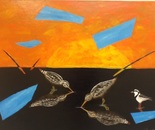 “Sunset & Waders on the Gwydir ”
As the last rays of sunlight hit the shallow water across the wetlands, waders fed.
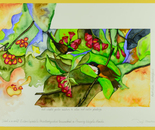 “Australia's Hummingbirds in Weigela”
[bird is a Verb] Watching Eastern Spinebill (Acanthorhynchus tenuirostris) feeding on Weigela (fam.Caprifoliaceae) I think they must be Australia's cousin to Hummingbirds of northern hemisphere.
When I see Coolibah Gum in the remnant wetlands of the Gwydir floodplain I am often reminded of old men, squatting down on their haunches, chatting about old times. I see two forms of Coolibah. The spreading laid back male form and the more upright female form, with long berthing limbs almost touching the ground before pushing to the sky at the extent. The young fresh Coolibah(Eucalyptus coolabah) sapling pushing up to the light, often at the edge of the last watering, speaks of the cycle of this special floodplain tree community.
A myriad of activity occurs when the Gwydir watercourses are flooded.
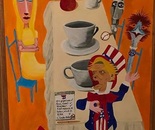 “Mad Hatters Tea Party (after Blackman)”
After Charles Blackman 1956 - posing a parody of world leaders around the Alice's tea table. The thinking populations (Alice) not impressed, the hare seeing time running out for us all and a brainless Pauline looking on. On his soapbox stands the Mad Hatter with his list of demands, regardless of their implications for other nations, the climate nor our ongoing human existence on planet earth.
A few of us spent a day in the nearby Australian bush, talking, drawing, laughing and painting. This is my somewhat angular study of that day. Great to amongst fellow artists for the day. The conversation over a cup of tea from a boiled billy was great.
An art piece for 2026 Science Week - Seeds for Science - The human connection to seeds.
Yam Daisy - Murnong (microseris) was a food staple for Australia's first nation people - Early (1800s) European settlers bought sheep and cattle that removed Murnong from the landscape.

 “Magpie Geese ”
 “Lignum & River Cooba Wetlands ”
 “Gingham Watercourse Wetlands ”
 “Nesting Ibis on Lignum”
 “Hungry Ibis Chicks”
 “Classic Gwydir Wetlands”
 “Egret Chicks”
 “Flooded Wetlands”
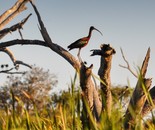 “Glossy Ibis ”
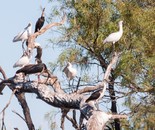 “Gwydir Waterbirds”
 “Bossy Red Wattles”
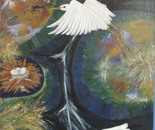 “Egrets in the Gwydir ”
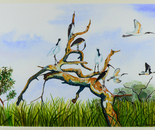 “Coolibah in the Gwydir”
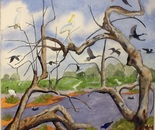 “Flooded Watercourse”
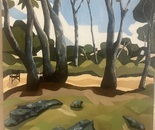 “A Day in the Bush”
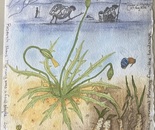 “Yam Daisy - Murnong”