29.09.26
WHEN A PAINTING BEGINS TO BREATHE: AN EXPERIMENT IN PRESERVING BRUSHWORK AND COMPOSITION
posted by Martyn Foster
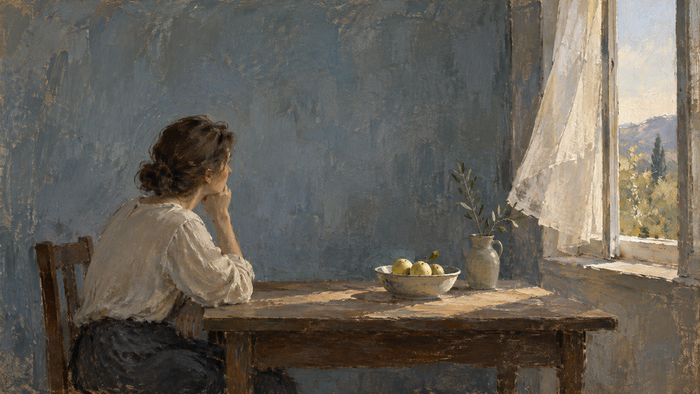
The painting is quiet: a seated figure near an open window, a bowl of pale fruit on the table, and a broad field of blue-gray wall holding the composition together. The face is suggested with only a few marks. Dry brush catches the weave of the canvas. Most of the painting’s energy comes not from action, but from the balance between the figure, the window, and the empty wall.
Turning this image into motion creates an immediate temptation. The curtain could lift, the figure could breathe, light could move across the table, and the camera could drift toward the face. Yet every added movement risks changing the very decisions that made the painting work. A brushstroke can become a texture. An intentional flat shape can become simulated depth. A quiet visual center can move somewhere else.
The experiment, then, is not “How much animation can this painting contain?” It is “How little motion is needed before the still image feels alive?” A short reference-driven draft made with a tool such as Vidu Q3 can help explore that question, but the source painting—not the novelty of movement—must remain the authority.
The First Decision: What Is the Painting Actually About?
Before imagining movement, the composition needs to be read as a painting. The figure occupies the lower-left area. The window forms a bright vertical on the right. The bowl creates a smaller, pale interruption between them. The blue-gray wall is not unused background; it is the area that gives the other forms room to hold their positions.
If the camera pushes toward the face, that wall disappears and the relationship changes. If the curtain moves too strongly, the brightest part of the image becomes the main event. If the figure performs an obvious gesture, the bowl and window become stage dressing. None of those choices is inherently wrong, but each one creates a new work rather than simply animating the original.
For this experiment, the central idea is stillness interrupted by breath. That gives motion a clear hierarchy: the figure may breathe; the curtain may respond slightly to air; the light may shift almost imperceptibly. Nothing should cross the painting merely to prove that it can move.
What Must Remain Still
The first preservation decision concerns composition. The figure’s head, the window edge, and the bowl form a triangular relationship. If any one of them drifts, the visual balance changes. The animation therefore keeps the camera fixed and treats those three anchors as non-negotiable.
The second decision concerns contour. The painter has left the shoulder edge partly unresolved. In a conventional animation workflow, there might be an impulse to clean it into a stable outline. Here, that ambiguity is part of the work. The shoulder should not gain a crisp digital border simply because motion needs a convenient mask.
The third decision concerns negative space. The blue-gray wall must not acquire shadows, cracks, or decorative detail that were absent from the painting. Generative motion often tries to make empty areas informative. In this image, the emptiness already carries information: it controls pace.
Letting the Brushwork Move Without Turning Into a Surface Effect
Brushwork creates a special problem. If every stroke remains perfectly frozen while the forms move underneath, the painting can look like a cutout. If the strokes crawl or shimmer independently, the surface becomes an animated filter and the hand of the artist disappears behind the effect.
The more respectful choice is selective stability. Large structural strokes stay attached to the forms they describe. The dark stroke defining the sleeve moves only as much as the breathing body requires. Small dry-brush flecks in the wall remain still. The highlights on the fruit may change slightly with the light, but they do not slide around the fruit as if it were a polished 3D object.
This distinction matters because painted light is not necessarily physical light. A bright mark may have been placed to balance another mark elsewhere, not to describe a literal reflection. Animating it according to simulated optics can make the scene more realistic while making the painting less faithful.
The Movement That Was Rejected
The most seductive idea is a slow camera move toward the figure. It promises intimacy and makes the result immediately look like “video.” It is also the movement most likely to damage the original composition.
As the camera moves closer, the window and bowl lose space around them. The figure begins to dominate the frame. To create parallax, the animation must decide how far the table sits from the wall and how much depth exists between the figure and window—information the painting deliberately leaves unresolved.
Rejecting the push-in is not a technical compromise. It is an artistic choice. The painting’s distance from the viewer is part of its emotional tone. Preserving that distance allows the small bodily movement to become noticeable without making it theatrical.
The Final Motion Design
The finished concept uses three restrained changes. The figure’s chest and shoulder rise by a very small amount over a long breath. The curtain edge shifts once, then settles. A band of soft light on the table changes slowly enough that the viewer may notice it only on a second look.
The face does not turn. The eyes do not perform a dramatic blink. The camera does not move. Sound, if used at all, would remain environmental rather than illustrative: distant room tone rather than a literal amplified breath.
This design does not try to reveal what happened before or after the painted moment. It extends the duration of that moment. The difference is important. Narrative animation asks the figure to do something; this experiment asks the viewer to remain with what is already there.
How to Judge Whether the Painting Survived
The result should be compared with the original at the beginning, midpoint, and end. The questions are visual rather than technical:
- Does the eye still land on the same area first?
- Do the figure, bowl, and window keep their relative positions?
- Does the wall still feel like intentional negative space?
- Do the strokes remain part of the forms rather than becoming a moving texture overlay?
- Has the face gained detail or expression that the painter never supplied?
- Does the motion deepen the original mood, or replace it with a new one?
If the animated version is more impressive but less recognizably the same painting, the experiment has crossed its boundary. The goal is not maximum motion fidelity. It is continuity of artistic intention.
When a painting begins to breathe, the strongest decision may be what not to animate. Motion can reveal rhythm already present in the brushwork, but only if composition, contour, and visual weight remain in charge. The image does not need to become a scene from a film. It only needs enough time for its silence to be felt differently.