
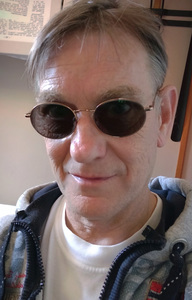
Location: Sweden
Born in Sweden and raised across Western and Southeast Asian cultures, Eric Jung creates evocative paintings bridging realism, abstraction, and philosophical inquiry.
While art has been his lifelong companion, Jung spent his first chapter as a specialist physician. He graduated from the Karolinska Institute, started a neurosurgery residency at Karolinska University Hospital, but ultimately specialized in Anesthesia, Intensive Care, and Emergency Medicine. This rigorous scientific background coexists with a deep reverence for nature, forged through years of single-handed sailing, hiking, climbing, and writing poetry—which he publishes in English, and in Japanese under the pen name Kumanoyama––熊野山, given to him by his “sensei”.
Jung’s artistic education is a nomadic apprenticeship. In his youth, he lived in Japan, studying Japanese, traditional art and calligraphy under master sensei Nakamura Soubaku, a foundational experience that shaped his visual language alongside later mentors in Thailand and Europe.
His early landscapes and portraiture have evolved into contemplative, sometimes improvised works. Inspired by Japanese poetry and internal psychological landscapes, he blends realism, surrealism, and abstract expressionism to capture the unseen forces of existence.
"Underlying my work is a deep-seated curiosity about the origin of being and the internal landscapes of the mind. I prioritize capturing the essence of a memory or an idea over rigid stylistic consistency.”
Working from his studios in South Sweden and Chiang Mai, Jung exhibits across the US, Southeast Asia, and Europe, and was recently recognized with the prestigious Award for Painting at the 2025 London Art Biennale.
"Ten years ago I decided to abandon my career as a consultant physician to be able to work full time with art, a decision I haven't regretted for a second."
Working from his studios in South Sweden and Chiang Mai, Jung exhibits across the US, Southeast Asia, and Europe, and was recently recognized with the prestigious Award for Painting at the 2025 London Art Biennale.
Paintings
"Perhaps it will be,
that that todays troubles one day,
will be sweet memories.
What I used to call sorrows,
I now remember with joy."
Kiyosuke
For every step I take,
One less will remain,
Leaves already autumn red.
As water flows from the hills,
Untill the ocean it fills.
E.J.
My wife, a fan of the Dutch 17th century painter Vermeer, wanted me to paint her in the style of his "Girl with a Pearl Earring", a request I could not deny.
After a poem by Kobayashii Issa that he wrote after his infant daughter had died from smallpox. In spite of sufferings life has to go on.
"This world of dewdrops,
This fleeting world of dewdrops,
And yet…and yet."
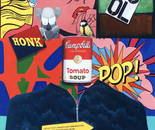 “Comment on American Pop Art 1.”
When I was studying American Pop Art artists,** I decided to make a painted comment. After the initial painting here I made two more on the themes of "Eros" and "Filia".
The jacket with zipper and the tomato soup can with a Great tit are mine, the latter more photorealistic than Warhol's and the quotes I got from Dali although they apply to me as well.
**Roy Lichtenstein, Christopher Wool, Robert Indiana, Edward Ruscha, Kaw, Jeff Koon, Mark Rothko, Keith Haring.
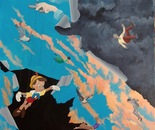 “Regarde Gepetto, regarde! Une hirondelle”
"Look Gepetto, look! A swallow."
Pinocchio, absorbed in seeing a swallow, is blinded to everything else.
An improvised painting that started with a completely blue painted canvas with no idea where it would end but my imagination led me to this.
This portrait was made during a period when I was studying Klimt, hence I let myself be inspired by his ornamental style and the use of gold leafs but kept my personal touch. The angular and round shapes describes her personality and the dress I designed myself. She was very pleased with this portrait.
Adrian is my second son, here 14, just entering puberty. Done in acrylics with charcoal and graphite powder.
Before and during my student years in Tokyo I read some of Yukio Mishima's books and like many others I liked them. He was the most famous writer in Japan at that time, probably the most well-known person even outside the cultural world and popular in spite of his politically incorrect views, the reason why he never got the Nobel Prize he was nominated for three times.
His ritual suicide by "seppuku" or harakiri stunned not only me but also the Japanese. I had for some time decided to make his portrait, one that mainly the Japanese would understand. It took me a few more books, a biography and watching several interviews before the picture formed in my mind and I was ready to paint it.
His "death poem", copied from the original, and his last note found on his desk are included.
Death poem:
A storm blows in the night,
I want to be the first to fall,
to the world and to man,
ahead of time.
Falling is the only way to be a flower.
Desk note:
If life is limited I want to live forever
The mask is a Atsumori mask used in a Noh theatre drama.
The Eurasian Goldfinch is a symbol of resurrection.
The Spider lily a symbol of death.
The notes from the Bach song;
"Komm, süßer Tod, komm sel’ge Ruh! ......
Komm, führe mich in Friede,
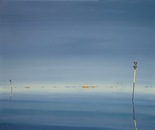 “Sunrise hour in the archipelago.”
Made after a memory when sailing in the outer Stockholm archipelago in the summer, sun rising around 3 am, wind still absent and the pleasure boat people still sleeping. My favourite time when sailing or especially kayaking.
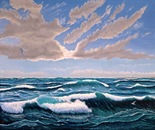 “Summer gale outside Sälskar lighthouse”
Memory from sailing in the Åland Archipelago, Baltic Sea. Two Arctic terns are included
The hand of death may move the wood,
And claim the King where once he stood,
The board is cleared, the shadows fall,
Yet, life returns to wake us all.
E.J.
After the Ingmar Bergman film "The 7th Seal"
The scene with the chess game between Death and the knight Antonius Block, just back after a crusade to the Holy Land, had been on my mind since youth. I worked as an camera assistant in my youth and wanted to be a film director but life took me in another direction. My interpretation is more hopeful, with the Eurasian Finch, a symbol of resurrection, showing that death never wins. I put myself in the place of the knight dressed in Samurai clothes.
Block: No man can live with death knowing everything's nothingness.
Death: Most people reflect neither on death nor nothingness.
夏空や
音もなき海に
寄る波の
あまりに平らに
消えんをおそる
Clear blue summer sky,
Over waves that move unseen,
Deep in silent breath,.
But then I fear that the light,
Will sink in shades of death,
Kumanoyama
散るは声
秋の想いは
深けけれど
遠き日帰る
光ありけり
熊野山
Past the drifting leaves,
though the autumn heart runs deep.
Yet there is a light,
returning me once again,
to days waking from their sleep
Kumanoyama
風荒れて
海に身を置く
内に凪
Fierce gales strike my soul,
I stand open to the storm,
Calm holds at the core.
Kumanoyama
A Haiku poem, calligraphy and painting by Eric Jung.
冬の夜、
星の向こうに、
永遠かな
Fuyu no yoru,
hoshi no mukou ni,
eien kana.
A dark winter night,
so many stars, and beyond,.
Ah, the eternity.
“After seeing photos by the Hubble telescope, the fascinating visualised stars, gas and dust formations of the universe, I painted the cosmos after these photos.
The poem appeared in my mind while working with the painting, memories of what it felt like when looking at the sky in winter-
time as a boy, and I felt it belonged there.”

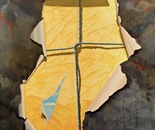 “Perhaps”
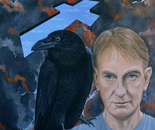 “Steps”
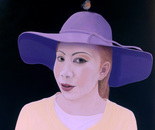 “Woman with a golden earing”
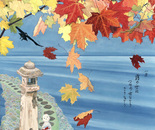 “Dewdrops”
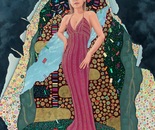 “Natalie”
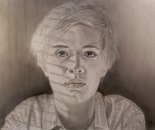 “Adrien, 14 yrs”
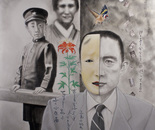 “Mishima”
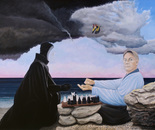 “Is it all Pointless”
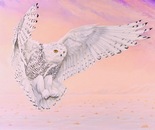 “Snowy Owl”
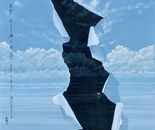 “Summer sky”
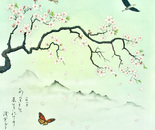 “Spring”
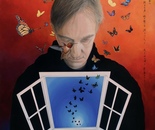 “Memories”
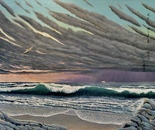 “autumn gale”
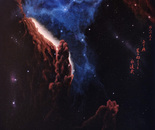 “Eternity”