
Location: Spain
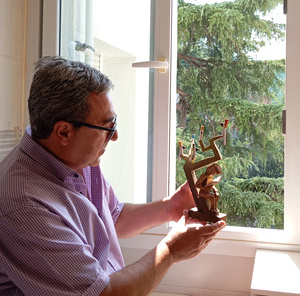
«Intento que mis creaciones inspiren momentos de reflexión y conexión con el mundo de los libros.»
Los temas centrales de sus obras giran en torno a la lectura. José Manuel, a través de figuras de líneas geométricas en escenarios irrepetibles, busca transmitir diversas emociones al lector. Sus composiciones creativas se basan principalmente en la madera.
https://solaresculturaleer.blogspot.com/
Latest wooden sculptures from the readers collection
A sculpture inspired by John Locke’s quote: “Education begins with a good gentleman, but reading, good company, and reflection must complete it.”
John Locke’s quote emphasizes that education is not a process limited to childhood or formal instruction, but rather an ongoing development of the individual. When he says that “education begins with the good gentleman,” he means that the early years (basic schooling, the instillation of values, habits, and discipline) lay the foundation for character. It is the starting point: without that initial foundation, it is difficult to develop a solid personality.
However, Locke asserts that this is not enough. “Reading, good company, and reflection must complete it” introduces the idea that true personal improvement depends on what one does after that initial education. Reading broadens the mind, exposes one to new ideas, and allows for learning beyond one’s own experience. Good company influences behavior, as the people we surround ourselves with shape our attitudes, aspirations, and values. And reflection acts as the integrating element: it is the process through which the individual analyzes, questions, and makes sense of what has been learned and experienced.
Overall, Locke proposes a view of education as a dynamic and lifelong process. It is not enough simply to receive instruction; one must actively cultivate oneself, choose one’s social environment wisely, and think critically. Only in this way can a person of true integrity be fully formed.
Unique piece. Signed by the artist. Artist's certificate included.
A sculpture inspired by Will Rogers’ quote: “A man learns in only two ways: one is by reading, and the other is by associating with people smarter than himself.”
Will Rogers puts forward a straightforward yet profound idea: human learning rests on two fundamental pillars—knowledge acquired individually and that which arises from interaction with others.
On the one hand, “by reading” symbolizes autonomous learning. Reading provides access to experiences, ideas, and knowledge accumulated over time. Through books, a person can educate themselves without depending on their immediate surroundings, broadening their perspective beyond what they directly experience. It is an active and personal process, where each individual develops their own judgment.
On the other hand, “through association with smarter people” introduces social learning. Rogers isn’t just talking about academic intelligence, but about surrounding oneself with people who contribute something valuable: experience, critical thinking, skills, or different ways of seeing the world. Being in contact with people who are more capable in certain aspects pushes one to question, improve, and learn more quickly and practically.
The key to the phrase lies in complementarity. Reading provides a theoretical foundation and breadth of knowledge; interaction with others offers contrast, application, and real growth. Without reading, learning can be limited; without good company, it can become isolated or incomplete.
Ultimately, Rogers makes a challenging point: to truly learn, it’s not enough to simply consume information; you also have to choose your social circle wisely. Because the people you surround yourself with end up influencing you just as much as the books you read.
Unique piece. Signed by the artist. Artist's certificate included.
Sculpture inspired by John Green’s quote: “Great books help you understand and feel understood.”
The quote expresses one of literature’s most profound functions: to broaden our understanding of the world and, at the same time, make us feel less alone.
On the one hand, great books help us understand because they allow us to encounter realities different from our own. Through stories, characters, and conflicts, we discover other eras, cultures, ways of thinking, and human emotions. Reading thus becomes a window into the human experience. A reader can understand fear, love, loss, or hope even without having experienced those exact situations. Literature broadens our perspective and fosters empathy, as it teaches us to put ourselves in others’ shoes.
But the phrase also highlights something even more intimate: books make us feel understood. Often, people experience emotions that are difficult to express: sadness, insecurity, loneliness, or confusion. However, when reading certain works, they encounter characters or reflections that seem to describe exactly what they are feeling. That recognition brings comfort, because it shows that other human beings have also gone through similar experiences. The reader no longer feels isolated and understands that their emotions are part of the human condition.
Furthermore, great books often raise universal questions about identity, the meaning of life, or human relationships. Even though they may have been written centuries ago, they continue to move us because they speak to feelings that remain relevant in any era. That is why literature creates a connection between authors and readers, even when separated by time and distance.
In short, John Green asserts that reading conveys not only knowledge but also emotional companionship. Great books teach us to better understand others and ourselves. Thanks to them, we discover that our emotions, doubts, and dreams can be shared, and that sense of being understood is one of the most valuable experiences literature offers.
Unique piece. Signed by the artist. Artist's certificate included.
Sculpture inspired by Joseph Brodsky’s quote: “There are worse crimes than burning books. One of them is not reading them.”
The quote invites reflection on the value of reading and the importance of knowledge in human life. Although burning books symbolizes the destruction of culture and ideas, the author asserts that there is something equally grave: ignoring books and voluntarily renouncing all that they have to offer.
Throughout history, book burning has been an act associated with censorship and authoritarianism. Destroying literary works means attempting to eliminate thoughts, knowledge, and ways of seeing the world. However, Brodsky points out that books also “die” when people stop reading them. A book forgotten on a shelf loses its primary function: to convey experiences, spark questions, and enrich the reader’s mind.
Reading is a fundamental tool for intellectual and personal development. Thanks to books, people expand their vocabulary, strengthen their critical thinking, and learn to better understand reality. Furthermore, reading allows one to engage with different cultures, eras, and ideas. Those who do not read limit their capacity for reflection and run the risk of passively accepting what others think. For this reason, a lack of interest in reading can become a form of cultural impoverishment.
The quote also highlights the emotional and human value of books. Literature helps us understand universal feelings such as love, sadness, fear, and hope. Often, a reader finds words in a work that express what they themselves could not put into words. In this way, books not only teach, but also provide companionship and help us better understand ourselves and others.
In today’s world, dominated by the fast pace of social media and instant entertainment, this reflection takes on even greater importance. Many people prefer brief, superficial content rather than dedicating time to deep reading. Brodsky thus warns of the danger of a society that abandons books, because without reading, analytical skills, imagination, and sensitivity diminish.
In conclusion, Joseph Brodsky’s quote advocates for reading as an essential human need. Beyond physically preserving books, what truly matters is reading them, valuing them, and learning from them. A book only comes to life when someone opens its pages and allows its ideas to transform the way they think and feel.
Unique piece. Signed by the artist. Artist's certificate included.

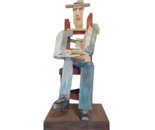 “Reader XCVII”
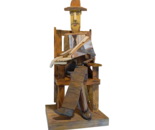 “Reader XCVIII”
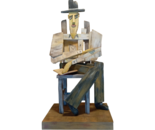 “Reader XCIX”
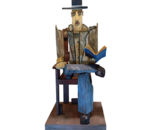 “Reader C”