

Location: Russian Federation
Igor Selivanov is a contemporary Russian realist painter known for his atmospheric depictions of ordinary moments and quiet domestic spaces. His work bridges the tradition of academic painting with a deeply personal vision, resulting in scenes that evoke memory and introspection.
Central to Selivanov’s practice is the interplay of light and stillness. He often stages compositions with personal objects that carry emotional weight—fishing gear, worn furniture, garden tools—transforming the mundane into scenes rich with narrative potential. Some elements are painted from life, others from photographs, allowing him to balance immediacy with careful arrangement.
He works on linen canvases primed with multiple layers of acrylic ground, using high‑quality oil paints to achieve depth and luminosity. This technical discipline supports his expressive goals: subtle tonal transitions, soft shadows, and a sense of air within the space.
Notable works include “In the Old Garden,” “Fisherman’s Table,” and “Cats on the Porch.” These paintings reveal his interest in memory and the subtle passage of time, creating spaces that feel both specific and universally resonant.
His works have been featured in group exhibitions and art catalogues, where his attention to detail and emotional subtlety have earned recognition among collectors interested in narrative realism and traditional craftsmanship.
E-mail: igorselivanov.com@yandex.ru
Site: https://igorselivanov.com/
This portfolio brings together four works in which the everyday acquires artistic depth. In the still lifes, ordinary objects — from fishing gear to an old cast‑iron pot — become carriers of personal and collective memory, while the intimate interior scenes capture the rhythm of private life. Using a hyper‑realistic painting style, the artist records fleeting states of light and the textures of wood, fabric, and metal, revealing the poetry of the mundane. The compositions are built on contrasts: old and new, stillness and a hint of action, natural and man‑made. The main aim of these works is not merely to depict the material world, but to convey its emotional aura and its connection to human experience.
The composition centers on a bouquet of daylilies in a clear glass vase: petals blend pink, yellow, and terracotta‑orange hues with fine veining and soft tonal transitions. The vase rests on an antique wrought‑iron bench with weathered wood; nearby lie a ripe yellow apple and a cluster of bright orange rowan berries. The background features dense dark‑green foliage and large grey boulders, contrasting with the warm color scheme of the bouquet. Chiaroscuro accentuates the volume of the flowers and the transparency of the glass, enhancing the sense of a fleeting sunlit moment.
This hyper‑realistic still life elevates the mundane to the monumental. The deep, neutral background dissolves space, focusing attention on a wooden tabletop densely populated with everyday objects: a translucent bottle catching diffused light, a bright yellow bucket with a label contrasting against the shadows, a casually placed green cap at the edge. A slice of bread, a pet‑food bag, fishing gear, sunglasses, and a spray can form a quiet chronicle of daily life — not staged, but seemingly observed. The meticulous rendering of textures — from the grainy wood surface to the subtle highlights on plastic — transforms the ordinary into the aesthetically profound. In oil paint, the work acts as a magnifying glass, revealing beauty in the overlooked.
A warm, intimate corner of an old house where time seems to slow down. Wooden floorboards, bathed in soft light, catch long shadows cast by a green stepladder and a half‑open door. A bag of “Chappi” pet food leans against the wall, lending the scene a touch of everyday simplicity. Two cats — one sitting alertly on a step, the other sleeping peacefully stretched out on the floor — become the emotional core of the composition. Their postures embody the contrast between wakefulness and rest, while the overall atmosphere conveys a quiet poetry of the ordinary. The meticulous rendering of textures — wood, fur, fabric — gives the painting an almost tactile realism; the oil technique tenderly preserves a fleeting moment, transforming a mundane interior into a lyrical statement.
The garden, which has become an extension of my destiny, traces its history back to 1940. Across 25 sotkas of land, a special world has taken shape: a landscape style where nature and human labour exist in harmony, and the old apple trees — now 80 years old — stand like guardians of the place’s memory.
I have been engaged in plant growing for exactly 40 years, and this garden is not merely a collection of plants but a space imbued with personal meaning. The desire to capture its beauty matured over several years. From spring through August 2025, I gathered visual material: I took photographs from various vantage points, observed the garden’s rhythms, the changing trimmings of the crowns, the way light fell on the foliage at different times of day.
The August view proved to be the best: the trees laden with ripe fruit, suffused with a quiet, mellow light. I added a few objects to the composition to intertwine the natural motif with everyday life — a pumpkin, a crate of apples, a plastic table. But the focal point, the heart of the meaning, became an old cast‑iron pot — an object with a history, a symbol of continuity and homey warmth.
I painted the picture over two months, striving not just to render a recognisable view but to preserve the very breath of this garden and the echo of my own forty‑year journey in plant growing. For me, this work is the fullest expression of my creative vision.

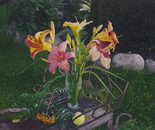 “Daylilies. Bouquet of Time”
 “The Fisherman's table”
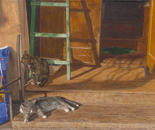 “Cats on the porch”
 “In the old garden”