
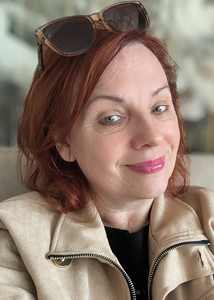
Location: Poland
Mariola Szreiber-Zdziebłowska is a visual artist whose work represents a unique dialogue between the raw geometry of architecture and a profound freedom of expression. Her journey with photography began under the influence of meetings with Zbigniew Filipiak and Stanisław Jasiński, which shaped the foundations of her technical skills. Currently, her process is guided by an unwavering credo: "To create primarily for oneself – to name one's own fears, feel the shiver of truth, and find one's own reflection in the matter of the world".
In her images, the artist pierces through matter to find the soul within. She creates to breathe life into her works during the editing process, using intuition as a compass that leads her to where the modern rhythm of life intersects with the echo of the past. Her art is a personal victory over the void of oblivion and proof that: "My eyes see the light of ancient stars, so that I may use them to brighten today's darkness".
The international stage of her career gained momentum through collaboration with curator Safa Büte (ArtQuake-14), which opened the door to prestigious projects promoted by Salvatore and Francesco Saverio Russo. An important link in her artistic network is also the collaboration with curators: Dr. Müberry Bülbül and Janarita Armooti.
Finalist of Artavita Open Call – a prestigious distinction confirming the international significance of her work.
Digital double exposure photography.
A study on the intersection of human form, architecture and nature
An interpretation of the transient human self merged with the eternal architecture of Amsterdam.
 “Ascension through Stillness (2026)”
A synthesis of the human form and the ethereal nature of a flower
A portrait of organic connection between human skin and the bark of a tree.
A profile portrait merged with stone, reflecting on our lasting presence.
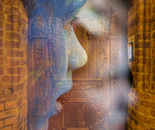 “Internal Architectures (2026)”
A study of emotions and memories through the human form and built environments.
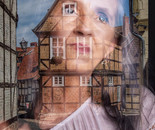 “House of the Soul. The Architecture of Endurance (2026)”
This work is a visual record of the symbiosis between human presence and the silent testimony of old walls. It represents the moment where personal memory meets the texture of history.
By merging the delicacy of a portrait with the raw structure of timber-framed architecture , I seek the "DNA of existence"- that which remains when everything else fades.
It is a portal for those who look for a passage to the truth hidden beneat the surface of the everyday..
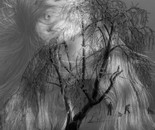
A metaphorical journey into the depths of winter's stillness.
In this composition, the delicate structure of frost -covered branches merges with the human silhouette , creating a bridge between the cycle of nature and the internal space of refllection. It is a visual poem about peace, patience, and the strength that gathers in silence before the awakening.
This image captures the moment when the world slows down, authentic rhythm..
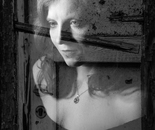 “The Key to Presence. The Unspoken Truth (2019)”
A visual exploration of the boundary between the internal world and external reality.
This piece captures the delicate moment of awakening , where the human spirit begins to emerge from the "stone" of past experiences. The raw texture of the wood serves as a veil that is slowly being lifted by the power of conscious awareness. It is a tribute to the courage required to look through the layers of time and finally see one's own authentic reflection.
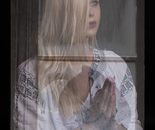 “The Glimmer of Hope. The Sanctuary of Silence (2026)”
This work is a contemplative study of light and spiritual peace. It portrays the human soul finding its inner sanctuary amidst the transparency of existence.
The layered composition suggests that true harmony is found not by escaping the world , but by looking through its frames with a heart full of gratitude.
It is a visual representation of the "personal anchor of peace" that allows one to harmonize even the strongest emotions.
 “The Rhythm of Ascent. The Harmony of the Inner Staircase ( 2026)”
This work captures the vibrant energy of personal growth.
The human form merges with the rhythmic structure of the stairs , bathed in celestial violets and deep blues. It is a visual representation of moving upwards , not just through the layers of one's own consciousness. The architecture of the building becomes the architecture of the soul, where every step is illuminated by an inner light.
 “The Fragility of Memory. The Red Blossom of Silence (2026)”
In this composition, the softness of a single red flower meets the rigid history of old architecture .
The translucent layers suggest a fleeting moment, a memory that is being held with care. It is a study of contrast between the transient beauty of life and the endurning strength of the places we inhabit. The gaze of the figure invites the viewer into a quiet dialogue with the past.
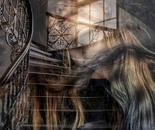 “The Threshold of Light. Echoes of the Inner Architecture (2026)”
This work explores the intersection of the physical world and spiritual perception.
The window serves as a portal, where external light dissolves the boundaries of the interior. The intricate patterns of the staircase and the ethereal presence of the figure create a sense of transition. It is a moment of clarity, where the soul recognizes its own reflection in the geometry of existence.
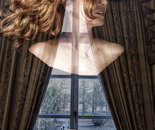 “The Window of Memory. The Quiet Gaze of the Past (2026)”
In this work, the transparency of the human figure merges with the stillness of the interior.
The window acts as a bridge between the inner world and the landscape of the past, captured in a cold, blue light. The heavy curtains frame a moment of deep reflection, where the presence of the woman becomes part of the room's history.
It is an exploration of belonging and the invisible threads that connect us to the places we inhabit.
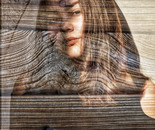 “The Texture of Being. The Whisper of Ancient Wood (2026)”
In this work, the human face is interwined with the organic patterns of aged wood.
The lines of the grain flow across the skin like currents of time, blurring the line between humanity and nature. It is a visual poem about the enduring connection to the earth and the layers of identity we carry within.
The gaze remains steady, emerging from the rough surface as a testament to existence and the strength of the inner spirit.
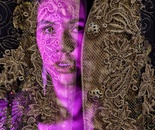 “Phantom Of the Golden age. A purple Echo in the Web of time (2026)”
Description:
This work serves as a visual bridge suspended between tangible matter and a virtual spirit. The woman’s face, veiled in lace, becomes a phantom that hovers above the heavy, baroque texture of gilded fabric, illuminated by an aggressive, neon-purple light. The contrast between the cool, digital glow and the warm, rich weave of golden threads creates a profound tension. It is a story of identity permeating through layers of time, of an echo from the past resonating within a modern network, becoming an elusive code—a visionary trace of existence. (2026)
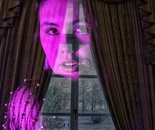 “SHADOW OBSERVER. A Gaze from Behind the Curtain of Time (2026)”
Description:
This work captures a moment of suspension between the internal and external worlds. A face bathed in purple light emerges from the deep darkness of heavy curtains, becoming an ethereal witness to the reality visible through the window. The blue daylight in the background contrasts with the mystical aura of the figure, creating a visual dialogue between the manifest and that which is hidden in the shadows of the soul. It is a portrait of intuition "pressing the handle" to unknown dimensions.
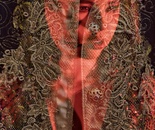 “IDENTITY CODE. The Fiery Structur of Being (2026) ”
Description:
In this work, the artist explores the boundaries between the human and the ornamental, as dictated by tradition. The woman’s face, illuminated by a hot red glow, permeates through an intricate lace pattern that seems to become a part of her very physicality. It is a visual record of emotions burning beneath the surface of convention. The golden details of the attire, almost regal in form, contrast with the raw energy of the red light, creating a portrait of a woman who finds her strength in the very heart of aesthetic chaos. (2026)
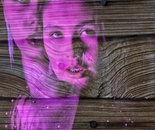 “WRITTEN IN THE GRAIN. The Biogenesis of Memory (2026)”
Description:
In this composition, the artist performs a symbolic unification of human presence with nature. Purple countenances, like afterimages of past moments, permeate the raw structure of wooden planks. The distinct grain of the wood and the visible traces of craftsmanship become a backdrop for an ethereal proof of existence. It is a visual metaphor for memory, which, though fleeting in its form, remains permanently etched into the matter of the world, becoming an integral part of it—a living echo of the past in the present. (2026)
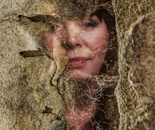 “Testimony of Presence. A gaze penetrating the cobwebs of time (2026).”
This work is an intimate record of the dialogue between human presence and the inexorable passage of time. The face, emerging from the raw texture of the wall and veiled by a fragile web, serves as a testament to the persistence of emotion within the world of matter. It is a visual metaphor for uncovering one’s own truth, which remains vibrant beneath the layers of oblivion and the dust of history. This piece is a victory over the void, a manifestation of existence in a place where time attempts to erase all traces.
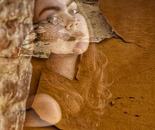 “Gaze Imprinted in Matter. Where Walls Possess a Soul. (2026)”
Description:
This work is not merely an image; it is a confrontation between two natures: fragile human emotion and raw, relentless time. This is a woman—not as an addition to the background, but as the pulsating heart of this composition. Her gaze, piercing through the cracked layer of plaster, is direct and arresting. She is not a passive observer, but a presence that animates the dead stone.
In the raw, ochre wall, with its decay and fractures, I find a space that becomes her home. This is the moment where the fragile and the human—the portrait, the glow of her hair—does not just struggle against the matter but permeates and transforms it. It is a testimony of a presence so powerful that it becomes part of the very structure of the world.
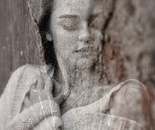 “Testimony of Presence – Echo.(2026)”
Description : This image is an intimate record of human sensitivity merging with the steadfast matter of the world. The delicate profile of a woman, embedded within the structure of cracked rock, serves as proof that the boundary between us and the past recorded in stone is but an illusion. It is a visual credo of overcoming the void through flow—a moment where the body and soul find their reflection in that which is permanent and unchanging.
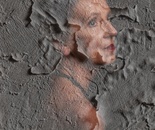 “Fissure of Truth – Shiver of Authenticity (2026)”
Description (EN): This piece presents a raw, genuine moment of existence. A portrait of a woman who makes no attempt to conceal her age or emotions breaks through rough, damaged concrete. Her red lips contrast sharply with the gray wall, while the clear profile and exposed shoulder create intricate weaves of intimacy and strength. This image-gateway does not seek the applause of the crowd, but speaks to those who can discern the weaves of presence and authentic wisdom—the pure essence of life.
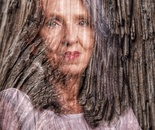 “Matter of Time: Whispers of Inscribed Life (2026)”
Description:
This work is an intimate dialogue between human presence and the enduring nature of the world. The face, emerging from the deep furrows of ancient bark, ceases to be a mere image and becomes part of the eternal rhythm of growth and passing. Every crack in the wood finds its reflection in the experience etched into the gaze, creating a unity where the boundary between the body and the matter of the world dissolves. It is a visual testimony to how our emotions and memories are inextricably woven into the texture of time that surrounds and shapes us.
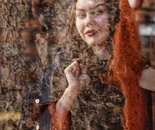 “Wall’s Testimony: Memory Hidden in Red (2026)”
Description (EN):
This work is a raw and poignant confrontation of human sensitivity with the unyielding matter of a wall. The red of the brick, interlaced with a network of joints, permeates the face, creating the impression that the person portrayed is both the foundation and the spirit of the place. It is a visual record of enduring "against the wall," where difficult emotions are forged into the permanence of stone. The gaze, though obscured by the structure of the matter, remains clear and conscious – a triumph of presence over the anonymity of concrete and clay. It is proof that even within the world's hardest structures lies a human story waiting for the light.
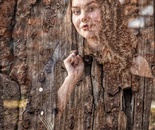 “Young Life in Old Wood: Energy and Endurance (2026)”
Description (EN):
This work is a visual metaphor for life germinating in the most unexpected places. A young woman, with a confident and clear gaze, emerges from the structure of an old, cracked tree trunk. Her figure, captured in a double exposure, seems to be part of the eternal cycle of nature – a fragile yet vital energy that needs a firm foundation to resonate fully. The gesture of her hand and her modern attire contrast with the rawness of the material, creating a dialogue between modernity and timeless endurance. It is a story of hope and strength born on the foundation of experience inscribed within the rings of time.
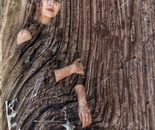 “Ring: Harmony of Existence (2026)”
Description (EN):
This work is a study of unity between the human silhouette and the raw structure of nature. The figure, aligned with the deep furrows of the wood, ceases to be a separate entity and becomes an integral element of living matter. The vertical lines of the trunk lead the eye upward, suggesting growth and steadfastness, while the gentleness of the gaze lends the hard bark an almost ethereal character. It is a visual story about finding one's own rhythm within the structures of the world—about the peace that emerges when we stop struggling against matter and begin to resonate with it.
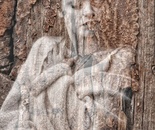 “Cocoon of Time: A Dream of Passing (2026)”
Description (EN):
This work is the most intimate and poetic image of the entire series. The figure, captured with closed eyes and wrapped in the soft texture of knitwear, seems to fall into a safe, internal sleep. The raw, rough structure of the ancient tree trunk is not a barrier here but a protective cocoon, isolating the subject from the world's noise. The double exposure blurs the lines between body and matter, suggesting a state of total reconciliation with the passage of time. It is a visual metaphor for the peace found in deep introspection, where passing becomes not a fear but a natural rhythm of existence.
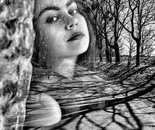
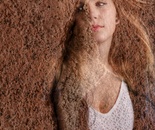 “Imprinted in Stone: The Silent Testimony of Existence (2026)”
This work is an intimate study of the relationship between the human form and the raw matter of the earth. Utilizing a double exposure technique, I have merged the portrait of a woman with the texture of rugged, fractured rock.
Visually, the figure appears to emerge directly from the stone, becoming an integral part of the landscape. Her hair flows naturally into the lines of the fissures, while the intricate pattern of her lace dress almost dissolves into the organic structure of the rock. The subject's calm, contemplative gaze contrasts with the harshness of the background, creating a tension between fragility and endurance.
This piece serves as a metaphor for our deep, inseparable bond with nature. It questions the extent to which our surroundings shape us and whether we can find peace and harmony by becoming one with them. It is a visual narrative of grounding, strength, and the natural beauty found in simplicity and authenticity.
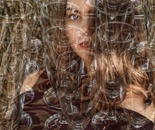 “Fragments of a Gaze: Reality Refracted (2026)”
This work is a captivating visual experiment, merging layering photography techniques with elements of surrealism. The central focus is a woman's face, captured in a rare moment of direct, penetrating eye contact with the viewer. Yet, her portrait is veiled and "filtered" through a dense array of transparent wine glasses.
The composition is rich in optical illusions. The glasses do not simply overlay the face; they create intricate patterns of distortion, reflections, and shadows. They alter the perception of depth, making the portrait appear trapped or concealed behind a glass curtain. The color palette is warm and saturated, with dominant browns and ambers, contrasting with the cool transparency of the glass.
This piece comments on perception, the filtering of reality, and the fragmented nature of human identity. The face, which should be paramount, becomes an element within a complex play of light and form. It is a visual metaphor for how we view the world (and each other) – often through the prism of conventions, expectations, or complex filters. It encourages the viewer to break through these layers in search of authenticity.
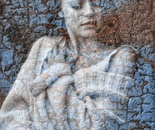 “Vestiges of a Gaze: Time's Intricate Etchings (2026)”
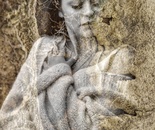
This work is a masterful fusion of a psychological portrait with an abstract texture, created through double exposure. The image depicts a woman in a contemplative pose, enveloped in a thick, knitted sweater. Her likeness, however, is completely integrated with the surface of old, cracked wood or metal, covered in peeling, azure paint.
The composition rests on the contrast between the softness of human tissues (and the sweater) and the harsh, degraded surface of the background. The cracks in the paint form a unique network of lines that traverse the woman's features, imbuing the image with the character of an ancient fresco or a deteriorating photograph. The color palette is muted, with dominant blues and rust tones, giving the piece a melancholic and somewhat dreamlike mood.
This piece serves as a metaphor for memory, time, and the impermanence of human existence. The woman's face appears to either fade into or emerge from these cracks, suggesting that our memories and identities are inextricably linked with the passage of time and its decay. It is a visual poem about the fragility of life and what remains – often only traces within the very structure of the world.
 “Threads of Memory: Silence Engraved (2026)”
This piece is another exploration of the human portrait within the context of raw matter, created using the technique of multiple exposure. The image depicts a woman in a pose of profound introspection and contemplative thought, enveloped in a thick, knit sweater. Her likeness, however, is fully integrated with the texture of coarse, fractured earth and dried, tangled roots or threads, giving the work the feel of an archaeological discovery.
The composition centers on the contrast between the soft sweater and the model’s delicate profile and the harsh, organic texture of the background. The color palette is muted and monochromatic, dominated by beige and brown, highlighting the severity and melancholy of the mood. The woman’s face is distinct, yet appears to merge into this sandy-earthen environment, creating unique depth.
This piece is a metaphor for memory, time, and deep rooting within the world. It suggests that our memories, identities, and thoughts are inextricably linked to the place we come from, eventually becoming a part of it over time. It is a visual poem about impermanence, showing how memory blurs and intertwines with physical reality.
 “Interior Monologue: Time's Delicate Etchings (2026)”
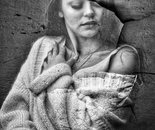
This piece is a profound and atmospheric study of human introspection, created through the technique of multiple exposure. The image depicts a young woman in a dreamlike, inner-focused state, with closed eyes and her hand tenderly pressed to her breast. She is enveloped in a thick, knitted sweater, which becomes one of the central elements of the composition.
The main focus of this work is its monochromaticity. The black-and-white finish emphasizes not only the delicate profile of the model but also the harsh, organic texture of the background, resembling cracked, dried earth or ancient rock. The woman’s face appears to either emerge from these rough structures, suggesting a deep rooting of her identity within the material world. Subtile tonal transitions and soft lighting imbue the work with the character of an old photograph.
This piece serves as a metaphor for memory, time, and the impermanence of human existence. The model’s face appears to fade into or intertwine with the cracks and textures of the background, creating unique depth and inviting the viewer into her intimate, dreamlike world. It is a visual poem about silence, peace, and the fragility of life, which leaves only traces within the very structure of reality.
 “The Unyielding Core .Layers of Resilience”
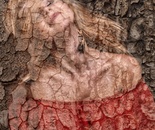
In this work, I explore the duality of human experience – the fragility of presence and the strength of survival. The double exposure merges a female silhouette in vibrant red with a cracked, raw texture resembling ancient bark or parched earth. However, this structure is not a sign of destruction, but a testament to fortitude and resilience against the passage of time. Femininity here becomes inseparable from the raw matter of nature. The title 'The Unyielding Core' symbolizes this inner, unbroken strength that remains intact even as the outer form changes. It is an image of victory over emptiness through the acceptance of one's own enduring nature, resonating with my 'instruction for the soul'.
 “The Origin of the Whisper .The Primal Gaze (2026)”
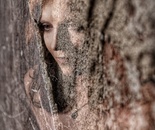
In this work, light acts as the primal sculptor, slowly carving the human form out of the absolute silence of the darkness. 'The Origin of the Whisper' represents the moment of transition between non-existence and being. I consciously use deep shadows to emphasize that the invisible carries as much weight as the illuminated. The depth of the subject's gaze acts as an instruction for the soul – a reminder of the inner strength that slumbers within nothingness. This is a visual record of my intuition, proof that the most authentic answers are hidden in darkness. The figure does not just emerge from the dark; she is in an intimate, endless dialogue with it. It is the victory of presence over emptiness, captured in a single, fleeting second.
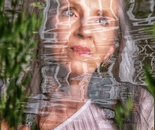 “ The Floated Memory. Reflection on the Whispering Presence (2026)”
In this piece, created in March, I explore the duality of human existence and the fragility of memory. The double exposure merges the figure of a woman with the atmospheric texture of water. What we see is a 'floated memory'—where the geometric lines of windows, symbolizing structure and time, mix with organic splashes of green leaves in the water's reflection. The figure appears suspended in this fluid landscape, nearly translucent. The only intimate and constant focal point is her red lips—a symbol of a whisper and a presence that refuses to be forgotten. It is an image of victory over emptiness, capturing the moment where the fragile meets the eternity of nature. This work resonates deeply with my internal 'instruction for the soul.
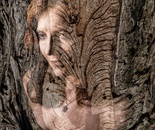 “ Trapped in Time: A Forgotten Voice (2026)”
This image is a mystical gateway to the past. We see a woman whose form emerges directly from the ancient, weathered trunk of a tree. Her face is contemplative, filled with deep melancholy, and her eyes seem to gaze into distant, forgotten eras. Between the deep, cracked furrows of the old bark, a figure appears, becoming a living part of the wood itself. Her presence in this petrified world is like an echo of a former existence—a forgotten voice that still resonates in the silence of an ancient forest.
The work is a profound reflection on transience, identity, and what remains of us in the world's memory. It is a "victory over emptiness"—proof that even if our form is trapped in time, our essence, our "former self," still lives in the corners of the world, like a whisper that only a few can hear. The texture of the old wood, with its deep crevices and cracks, tells the story of centuries passed, and the woman's figure becomes its vital witness.
Trapped in Time: A Forgotten Voice" is a piece for those who are not afraid to look into the eyes of a forgotten past. It is an invitation to listen to the whisper of ancient wood and discover within it the echo of one's own existence—the echo of old emotions and dreams that still dwell in the world's hidden places. It is a triumph of truth which, though imprisoned in hard matter, still beats with a bright, living light, much like the secret pulse of the ancient tree.
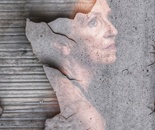 “Form's Prisoner: Veiling Truth (2026)”
This image is a powerful vision of the struggle between spirit and matter. The figure of a woman, with her delicate features, appears trapped beneath a thick, coarse layer of petrified texture—resembling concrete, bark, or ancient rust—that tightly encases her. The work depicts the process of unveiling, the transformation of something hard into fragility. It captures the moment when the truth of our identity, our "exposed soul," breaks through the tough shell imposed by the world or by our own defenses.
"Form's Prisoner" is a profound reflection on identity, freedom, and the courage to be oneself. It is a "victory over emptiness"—proof that even if the soul is confined within hard matter, its essence, its "true self," continues to live in the world's hidden corners, like a whisper that only a few can hear. The piece encourages the viewer to question their own identity and the bravery required to reveal the truth hidden beneath the layers of life’s demands and fears.
This work is for those who are not afraid to look into the eyes of a forgotten past. It is an invitation to listen to the pulse within the ancient matter and discover the echo of one's own existence—the echo of old emotions and dreams that still dwell in the world's silent places. It is a triumph of truth which, though imprisoned, still beats with a bright, living light.
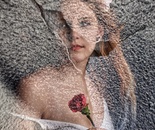 “Fissure of Hope: Flower in Stone. (2026)”
This work is a poignant story about fragility that possesses the power to shatter the hardest barriers. The figure of a young woman wearing a floral crown, holding a single, intensely red flower, emerges from a deep fissure in raw, cracked concrete. It is a visualization of the principle of transforming the hard into the delicate. The image suggests that even in the most inhospitable, "petrified" environments, life and beauty find a way to reveal themselves.
The red flower becomes the focal point—a symbol of love, memory, and the resilience of the spirit. It is a "living echo" of the past that refuses to be forgotten, breaking through the layers of mundanity and oblivion. The girl appears to be the guardian of this beauty, a being from the borderlands of dreams and reality, who lends a soul to dead matter through her very presence.
Fissure of Hope" is a piece about the triumph of life over emptiness. It invites the viewer to find that same courage within themselves—the courage to be delicate in a hard world. It is a triumph of truth which, though hidden in the shadows of the cracks, shines with a bright light, reminding us of what is most authentic and pure within us.
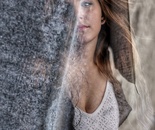 “Exposed Soul: Awakening in Shadow. (2026)”
This image is a sensual and mysterious vision of awakening. A woman's figure, with her delicate features, emerges directly from deep shadow, as if from the very "fabric" of reality itself, which cracks under her influence. The work depicts the process of unveiling, the transformation of something hard into fragility—the moment when our soul, our "exposed identity," shines brightly within the hard matter of the world.
Exposed Soul" is a profound reflection on identity, freedom, and the courage to be oneself. It is a "victory over emptiness"—proof that even in deep shadow, our essence, our "true self," still lives in the world's hidden corners, like a whisper that only a few can hear. The piece encourages the viewer to question their own identity and the bravery required to reveal the truth hidden beneath the layers of life’s demands and fears.
This work is for those who are not afraid to look into the eyes of their own shadow. It is an invitation to listen to the pulse within the ancient matter and discover the echo of one's own existence—the echo of old emotions and dreams that still dwell in the world's silent places. It is a triumph of truth which, though imprisoned, still beats with a bright, living light.
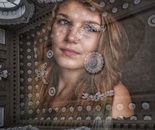 “Wings of Thought: Dome of Memory (2026)”
This composition is a mesmerizing moment where the intimacy of a portrait meets the monumental geometry of imperial architecture. Captured in the historic Gloriette in Vienna—a place of reflection and light—the intricate ceiling does not merely serve as a backdrop; it becomes an integral part of the subject’s essence. It is as if the ornate rosettes are a visual manifestation of inner thoughts, soaring toward the open sky that once inspired royalty.
The artist explores the "internal architecture" of the soul, suggesting that our memories and emotions are as enduring and majestic as the stone of historic monuments. Through the delicate use of double exposure, the work bridges the gap between the transience of a human moment and the timelessness of a place designed for beauty and perspective.
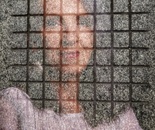 “Soul’s Grille: Borders of Gaze (2026)”
This poignant composition juxtaposes the intimacy of a self-portrait with the uncompromising geometry of a raw grille carved into the granite of the Vienna subway. This spontaneous creation became a visual metaphor for isolation and the internal barriers that modern humans confront. The artist's face, looking directly at the viewer, is both imprisoned yet serene.
Statement: This piece is a provoking dialogue between hard structure and fragile human existence. It suggests that even in a state of confinement, our identity and gaze remain free. The raw, grey texture of the granite contrasts with the delicacy of the portrait, creating a tension that New York curators describe as the 'poetry of restriction.' The work is a record of the struggle to preserve one's self in a world dominated by systems and structures.
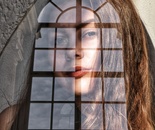 “Window of Consciousness: Passage of Light (2026)”
In this work, the portrait merges with the classical form of an arched window, creating a visual bridge between the interior and the outside world. It is no longer a "grille"—it is a portal. The sharp light falling on the artist's face emphasizes a moment of insight and clarity, suggesting that every architectural structure is essentially a frame for our perception of reality.
Statement: This piece explores the relationship between identity and perspective. Utilizing the symmetry of the Viennese Gloriette window lends the composition a sense of peace and rhythm, while the facial features emerging through it add a layer of deep personal truth. It is a record of a moment when the external world becomes part of our internal architecture, and light becomes the only guide through the labyrinth of memories.
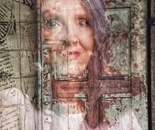 “Record of Survival: Echo of Old Doors (2026)”
In this work, inspired by old, damaged doors discovered at a Vienna subway station, the portrait gains a dramatic, almost physical dimension. The peeling, red texture overlays the artist's face and dress, creating a visual metaphor for the scars and traces that time and history imprint on fragile human existence. This spontaneous creation is an act of courage to reveal the beauty within imperfection and endurance.
Statement: The piece explores the relationship between identity and the history of a place. The raw, red texture of the old doors, reminiscent of healed wounds, contrasts with the calm, determined gaze of the subject. It is a record of the soul's resilience, integrating the traces of transience, making them part of its own narrative. It suggests that even what seems destroyed and rejected possesses its own sanctity and profound truth.
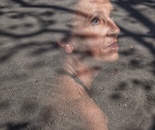 “Map of Shadows: Written on Skin (2026)”
In this intimate and meditative composition, the artist's portrait, captured in a profile looking upward, enters into a deep, organic dialogue with the raw shadows of trees cast upon the earth. This spontaneous creation is the moment when a human becomes part of nature's cycle, and their identity merges with the texture of the trunk, branches, and soil. It is a record of acceptance of transience and the search for unity with the universal order of the world.
Statement: The piece explores the relationship between identity and nature. The shadows of trees, resembling a map of life or drawings on the body, overlay the artist's skin, suggesting that our stories are inscribed not only in words but in the material we interact with. The raw, organic texture contrasts with the calm, uplifted gaze, creating a tension that New York curators describe as the 'poetry of organic unity.'
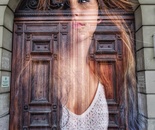 “Guardian of Memory: Facade of Existence (2026)”
In this monumental composition, the portrait of a young woman merges with the heavy, historical doors of a Warsaw tenement house. This encounter creates a visual narrative about what is enduring and what is transient within the city's fabric. The carved wood overlays the silhouette, suggesting that human identity is inextricably intertwined with the history and architecture of the places we inhabit. The wind-swept hair introduces an element of movement and freedom, breaking the rigid order of the old wood.
Statement: The piece explores the theme of barriers and intergenerational heritage. Doors, serving as symbols of transition, here become a transparent veil through which a contemporary presence emerges. It is a record of seeking continuity between ancient architecture and modern sensibility. Curators appreciate the masterful handling of texture, which gives the portrait an almost sculptural, timeless quality, typical of the Warsaw spirit of rebirth.
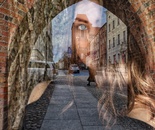 “Oko Miasta: Gaze of the Past (2026)”
In this monumental composition, the portrait of a young woman becomes a portal leading deep into the historical fabric of a city inscribed on the UNESCO World Heritage List. The Gothic brick arch—a fragment of world-class architecture—overlays the silhouette, creating a structure of arms that appear to shelter this unique heritage. This spontaneous composition is a visual unification with history, where human presence and the sanctity of ancient walls become one.
Statement: The central point of the work is the eye of the subject, overlaid by the clock face on the tower of St. John's Cathedral—a monument of the highest historical class. This visual coincidence creates the impression of an "all-seeing eye," connecting human perception with the passage of centuries recorded in the mechanism of time. It is a record of seeking continuity between the contemporary soul and the monumental history that has stood the test of time. Curators appreciate the masterful handling of texture and symmetry, giving the work a timeless, almost sculptural character.
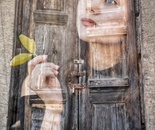 “Hope in the Door: Echo of the Past (2026)”
In this poignant and tension-filled composition, the portrait of a young woman merges with the raw, dark texture of historic, cracked doors. This spontaneous composition is a visual narrative about what is enduring and what is fragile. The dark, deeply carved panels overlay the bright silhouette, creating a visual metaphor for the barriers and non-accessibility that time and history imprint upon fragile human existence.
Statement: The central point of the work is the bright, green leaf held by the subject. This single, life-filled element contrasts with the petrified texture of the old wood, becoming a universal symbol of hope and rebirth. It is a record of seeking continuity between ancient heritage and the contemporary soul, suggesting that even behind the most closed and inaccessible doors of the past, a small sanctity is hidden—the seed of new life and truth. Curators appreciate the masterful handling of texture, giving the portrait an almost sculptural, timeless character.
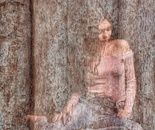 “Heart of the Tree: Inscribed in Rings (2026)”
In this monumental and meditative composition, the portrait of a young woman becomes an organic part of the raw texture of old wood. This visual merging is an act of intuitive unification with nature, where human presence and the history of the trunk become one. The subject's body loses its fragile form, gaining an enduring, rough texture that suggests deep rooting in the universal order of the world.
Statement: The piece explores the relationship between identity and nature. The vertical wood rings, resembling a map of time or lines of life, overlay the subject's skin and clothing, suggesting that our stories are inscribed not only in words but in the material we interact with. The raw texture contrasts with the calm, uplifted head, creating a tension that New York curators describe as the 'poetry of organic endurance.
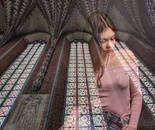 “The Temple of Presence: The Permeation of Time 2026”
In this work, the boundary between the human being and architecture is completely blurred, creating a visual record of coexistence. The figure is not merely an observer here, but becomes part of the structure – her emotions and physicality permeate through the Gothic vaults and the light of stained glass. It is a moment when "the curtain of everyday life falls," and we are confronted with the duality of being: that which is fragile and human, and that which is monumental and eternal.
This image is a continuation of my search for the "shiver of truth." By using the technique of overlapping visions, I strive to capture a state where our internal voices become as real as the walls surrounding us. This is not just a photograph of a cathedral interior; it is a portrait of a spiritual space where every line of the vault finds its reflection within the person.
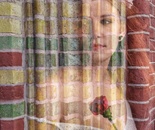 “Architecture of Longing: The Permeation of Fragility 2026”
In this work, the ultimate confrontation between matter and spirit takes place. The monumental, rhythmic brick architecture becomes a transparent veil through which fragile human existence breaks. The figure, adorned with a floral wreath and holding a red rose, is not merely a decorative element; she is the living pulse of this wall. It is a visual record of the state of 'flow' – a moment when external structures cease to be an obstacle and become a vessel for internal emotions and longing. This work represents the duality of endurance: the wall that bears witness to the past, and the moment that bears witness to the artist’s presence in the 'here and now"
 “Pulse of Endurance: Echo of Dissolved Motion (2026)”
This work serves as a dynamic counterpoint to my explorations within the medium of stone. Here, time and motion become the primary materials. The figure, held in a static, dignified pose, is encircled by a streak of dissolved light and energy. It is a visual record of the state of 'flow' – a moment when physicality fades, and only pure presence and the pulse of endurance remain. Through the technique of long exposure and editing, I aim to capture the intangible: the shiver of authenticity that arises when we stop reproducing reality and start pulsing with it.
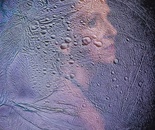 “Event Horizon: Echo of Cosmic Presence ( 2026)”
In this work, the ultimate blur occurs between intimate human presence and the monumental matter of the universe. The profile of a female face, held within a spherical form, merges with the raw, cratered texture of an alien planet. It is a visual record of the state of 'flow' expanded to a cosmic scale. My editing technique serves to capture the duality of existence: the fragility of individual life and the eternity of stellar matter. This work is a 'proof of existence' that transcends the boundaries of time and space, standing as a silent testament to our unity with the cosmos.
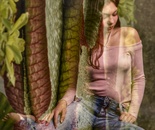 “Columns of Victoria: The Permeation of Fragility ( 2026)”
In this work, the ultimate fusion of the fragility of human existence with the monumental force of natural matter occurs. The Palmiarnia scenerie in the Habsburg Summer Palace became a temple where the raw, ribbed undersides of giant Victoria leaves form columns into which the bare, seated silhouette merges. My editing technique serves to capture the intangible – the state of 'flow,' where the boundaries between the body and nature fade away. This work represents the duality of endurance: the organic force that bears witness to the eternity of life, and the moment that bears witness to the artist’s presence in the 'here and now'. It is visual proof that our presence is universal.
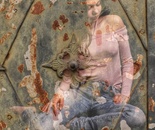 “Armor of Time: Echo of Inevitable Endurance (2026)”
In this work, the fusion of fragile humanity with the raw, rusting materie of an ancient, decaying gate creates a dialogue about inevitable endurance and the traces of time. The female figure, with her silent, oniric presence, gains an 'armor' of forged metal and corrosion, becoming a symbol of survival. This work, where the painful truth of material decay meets pure human presence, is my subsequent victory over the void, bearing witness to that which endures within us
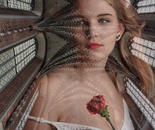 “Cathedral of Identity: Awakening of the Echo (2026)”
The artwork is a multilayered composition where the human form and Gothic architecture intertwine, creating an indissoluble unity of matter and spirit. The central figure of a woman, adorned with a delicate floral wreath and holding a red rose, becomes a "living vessel" for the raw beauty of the brick walls and soaring vaults of St. John's Church.
The double exposure technique makes the vault ribs appear to emanate directly from within the figure, suggesting that the architecture is not merely a backdrop but an internal scaffolding of emotion. The play of light filtering through the stained-glass windows at the bottom of the composition adds a sacred character, emphasizing the moment of transition between the physical and the ephemeral. It is a visual record of a state of flow, where the boundaries between the body and the history etched in stone completely dissolve, revealing the truth hidden beneath the curtain of everyday life.
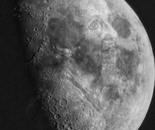 “Submerged in the Heavens: Light of Ancient Stars (2026)”
In this work, the human face ceases to be a mere portrait and becomes a map of cosmic memory. By overlaying the texture of the lunar landscape onto the features of the face, the boundary between matter and spirit dissolves. This is a visual record of a state where the silence of the universe meets the inner voice, and transience is captured in a form immune to the passage of time.
The titular light of ancient stars is a metaphor for wisdom and emotions which, though born in the past, continue to illuminate today’s darkness. This piece represents a personal victory over emptiness; it is proof that each of us carries infinity within, and our existence is inextricably intertwined with the rhythm of the cosmos.
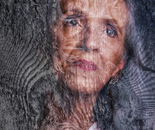 “Crystallization of Presence .A Portrait Inscribed in Salt and Wood”
In the presented work, Mariola Szreiber-Zdziebłowska performs a bold synthesis of human biology with the raw matter of nature. Utilizing the technique of double exposure, the artist merges a portrait of a mature woman with the texture of wood from brine graduation towers, upon which crystalline salt has settled.
The salt plays a pivotal role here—it is not merely a mineral deposit, but a symbolic protective layer that "freezes" emotions in time. The viewer is left with the impression that the figure in the photograph is not so much fading away as undergoing a process of crystallization, becoming part of a permanent, unchanging structure of the world. The rawness of the wood and the coldness of the salt crystals contrast with the deep, vivid gaze of the eyes, which remain the sole point of pure consciousness. It is a "proof of existence" inscribed in matter that endures longer than a human life.
 “Reborn in Stone: The Pulse of Nature 2026”
This work is a study of the unity between human sensitivity and the unshakeable permanence of nature. Through the technique of double exposure, the figure of a woman wearing a floral wreath—a symbol of blossoming and transience—is etched into the raw structure of a stone block. It is a visual record of a moment where the boundary between the body and the world's matter blurs, creating a new, spiritual essence.
The red rose, held close to the heart, becomes the only pulsing point of life, challenging the cold eternity of the stone. The image serves as a tribute to the "shiver of truth" and a personal victory over the void, demonstrating that even in the hardest matter, one can find a reflection of their own soul. It is a portrait of a presence that needs no words to manifest its strength.
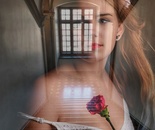 “Inner Horizon: Architecture of Light 2026”
This work serves as a visual metaphor of the human being as a space where the external world intertwines with internal peace. Through subtle layering, the figure becomes one with the architecture—the window positioned at eye level symbolizes clarity of perception and an openness to new horizons. The white garment and flowers express a newly found harmony and rebirth. The horizontal lines in the lower part of the image provide a musical rhythm, suggesting that the soul in this state is like a tuned instrument, ready to resonate with its own truth.
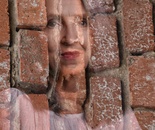 “Witness of the Wall: Memory of Matter 2026”
This work is a profound reflection on the permanence and intertwining of human experience with the matter of time. The woman's face, merged into the raw structure of a brick wall, suggests an unbreakable bond with the past and the foundations of one's own identity. The cracks in the bricks resonate with the delicacy of her features, creating a dialogue between the fragile and the indestructible. It is a portrait of a woman-as-foundation, who does not merely exist within reality but becomes an integral, conscious part of it.
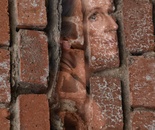 “Voice of the Wall: A Glimpse of History 2026”
This piece depicts human presence as an integral part of the material world. The figure's profile, merging through a raw brick wall, symbolizes thoughts and emotions that become "recorded" in the spaces we inhabit. It is a visual metaphor for permanence—the figure is not separate from her surroundings but emerges from them, suggesting that every wall and every structure carries a human imprint. The figure's focused gaze adds depth to the composition, inviting reflection on what remains immutable and strong within us, much like a foundation.
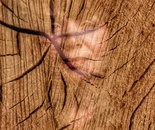 “Imprinted in Wood: A Testimony of Endurance 3026”
This work is a poignant study of the unity between humanity and the history written in matter. The woman’s face, emerging from behind a dense network of growth rings and cracks in an ancient tree trunk, does not merely sit upon them—it seems to grow from them, becoming a living part of time’s organism.
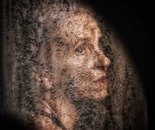 “Internal Architectures: The Anatomy of a Hidden Soul (2026)”
The portrait reveals a state of total immersion into the depths of one's own identity, where the human face becomes one with the organic texture. The gaze captured in semi-profile does not seek the attention of the crowd, but turns toward the internal echo of truth. It is an intimate record of emotions, where that which is hidden and forgotten begins to burn with its own subtle glow under the influence of light, revealing the intact architecture of the human interior
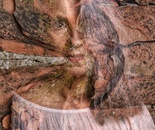 “Testimony of Matter: Truth Without Masks (2026)”
The artwork presents overlapping images of human presence and a cracked, stone structure, serving as an artistic record of the search for authenticity. The face and figure emerge from the fissures in the rock like a living truth hidden deep beneath the surface of everyday life. The interpenetration of structures symbolizes a return to the roots and a moment when intuition leads us to a complete, sincere union with nature and our inner self.
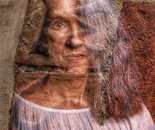 “Conscious Gaze: The Architecture of Inner Strength (2026)”
The artwork presents a vivid portrait of a woman, whose structure interweaves with the raw texture of a brick wall. The central point of the composition is a deep, piercing gaze that seems to overcome material barriers and the limitations of time. It is an artistic record of resilience and presence, which not only documents the passage of time but, above all, becomes a source of inner strength for the viewer, inspiring them to find their own voice and solid ground beneath their feet.
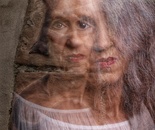 “Multiplied Presence: A Gateway to Hidden Truth (2026)”
The artwork movingly materializes the phenomenon of overlapping images and visions, becoming an artistic record of a profound search for one's own identity in silence. The double countenance and interpenetrating contours of the face merge with the raw structure of the wall, creating a space for internal dialogue. This art touches the world beyond the boundaries of everyday perception—it is a manifestation of sincerity, freedom from masks, and a personal victory in finding one's own reflection within the matter of the world.

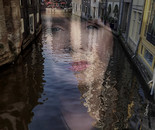 “Amsterdam Reflection (2026)”
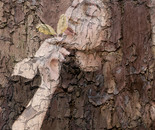 “Flesh and Bark (2019)”
 “Imprinted in Stone (2019)”
 “Winter Dream (2026)”
 “ Certificat”
 “ Certificat”
 “Certificat”
 “Certificat ”
 “ Certificat”
 “ Certificat”
 “ Certificat”
 “ Certificat”
 “Code QR”