
Location: United Kingdom
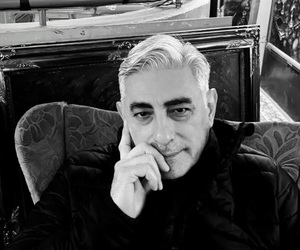
Camilo Tomas is a contemporary artist whose work blends surrealist imagination with emotional depth and symbolic narrative. Active since the mid‑1970s, his practice explores themes of transformation, identity, and the tension between the spiritual and the human. His paintings often feature dreamlike, psychologically layered compositions that invite viewers into introspective and symbolic worlds.
His work has been exhibited internationally, including a notable presentation at the Museo de los Ángeles in Madrid. Camilo’s ability to merge classical technique with surrealist vision has earned his pieces lasting relevance and strong interest among collectors of European surrealism.
He continues to create work that challenges perception and evokes reflection, resonating with both contemporary audiences and admirers of surrealist tradition.
Biography + Artist Profile
About the Artist: Camilo Tomas
My creative journey begins with the vastness of the natural
world—the depth of the sea, the permanence of the mountains, and the infinite theatre
of the clouds. Whether I am working on a delicate watercolour or a massive
three‑meter
oil canvas, I search for the unique objects and ideas that nature leaves behind
and reinterpret them through my own lens. Each piece is designed to be a quiet
space for contemplation.
The Experience: A Story for the Seeker
My paintings often feature a vast, quiet space with a
single, striking object. This is intentional. I want to draw the viewer’s eye
to a point of mystery and challenge them to find what nobody else can. I do not
tell the viewer what to see; instead, I provide the landscape and the clues,
allowing each person to discover a story that belongs to them alone. At
*Elusive Horizon*, the painting is only half of the experience—the other half
is what you find within it.
Gallery: Elusive Horizon
Specialization: Positive Narrative Surrealism Oils & Watercolours
The Philosophy: Beyond the Visible
I believe that nature is not merely a landscape to be
observed, but a storyteller waiting to be heard. My work is an invitation to
look past the immediate and find the ‘unseen reality’ that exists just behind
the horizon. While my style draws inspiration from the technical precision of
the surrealist masters, my focus remains on the light, the positive, and the
imaginative possibilities that nature provides us every day.
The Process: From Sketch to Scale
Every artwork begins with observation—of skies, seas,
stones, shadows, and the quiet objects the world leaves behind. From small watercolour
studies to expansive oil canvases, I translate these natural fragments into
symbolic forms. The process is slow, deliberate, and meditative, allowing each
piece to evolve into a space where the viewer can pause, breathe, and reflect.
Professional Bio / Background
Camilo Tomas is a contemporary artist specializing in surrealist landscapes of all sizes. With a foundation degree in fine art, interior design, and structural building, he blends technical precision with poetic surrealism. His gallery, Elusive Horizon, invites viewers into a space where reality and imagination meet, offering works that are both visually and contemplatively engaging."
In addition to my focus on surreal landscapes, I’ve studied fine art, interior design, and structural building. This multidisciplinary background allows me to merge architectural elements with artistic expression, creating unique and immersive visual experiences."
Biography + Artist Profile
About the Artist: Camilo Tomas
My creative journey begins with the vastness of the natural world—the depth of the sea, the permanence of the mountains, and the infinite theatre of the clouds. Whether I am working on a delicate watercolour or a massive three‑meter oil canvas, I search for the unique objects and ideas that nature leaves behind and reinterpret them through my own lens. Each piece is designed to be a quiet space for contemplation.
The Experience: A Story for the Seeker
My paintings often feature a vast, quiet space with a single, striking object. This is intentional. I want to draw the viewer’s eye to a point of mystery and challenge them to find what nobody else can. I do not tell the viewer what to see; instead, I provide the landscape and the clues, allowing each person to discover a story that belongs to them alone. At *Elusive Horizon*, the painting is only half of the experience—the other half is what you find within it.
Gallery: Elusive Horizon
Specialization: Positive Narrative Surrealism Oils & Watercolours
The Philosophy: Beyond the Visible
I believe that nature is not merely a landscape to be observed, but a storyteller waiting to be heard. My work is an invitation to look past the immediate and find the ‘unseen reality’ that exists just behind the horizon. While my style draws inspiration from the technical precision of the surrealist masters,In addition to my focus on surrealism, I also explore a concept I call ',suenaturalism,' which my focus remains on the light, the positive, and the imaginative possibilities that nature provides us every day.
The Process: From Sketch to Scale
Every artwork begins with observation—of skies, seas, stones, shadows, and the quiet objects the world leaves behind. From small watercolour studies to expansive oil canvases, I translate these natural fragments into symbolic forms. The process is slow, deliberate, and meditative, allowing each piece to evolve into a space where the viewer can pause, breathe, and reflect.
Professional Bio / Background
Camilo Tomas is a contemporary artist specializing in large or any scale surrealist landscapes. Mastering both oil and watercolour, his work ranges from intimate sketches to expansive 3m × 2m canvases. His style—often described as *Natural Surrealism*or a new concept called SUNATURALISM,,combines technical precision with a poetic exploration of barren terrains, vast skies, and symbolic objects. Through his gallery, *Elusive Horizon*, he invites viewers to explore the shifting boundary between reality and imagination, offering artworks that serve as both visual journeys and contemplative spaces.
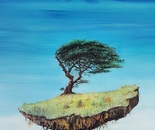
Floating Tree
price £595 + frame included
Atlantic Drift
Oil on Canvas
The Narrative
Inspired by the artist’s years living along the rugged North Devon coastline, Floating Tree is a poignant exploration of displacement, resilience, and the persistence of memory. The tree itself bears the physical scars of the Atlantic—its boughs permanently bent and sculpted by the relentless coastal winds that define the North Devon landscape.
Symbolism and personal History
By severing the land from the horizon, the artist transforms a familiar coastal memory into a surreal "island of the mind." The exposed roots suggest a life that remains nourished by its origins, even when the physical ground beneath it has been removed. It captures the essence of living on the edge of the Atlantic, where the elements are both a creative and a destructive force.
This work serves as a portrait of "belonging" that transcends geography. It is a reminder that we carry our home, our personal weather, and our roots with us, drifting through the vast, blue unknown of life's many transitions. It stands as a testament to the endurance of the spirit against the prevailing winds of change.
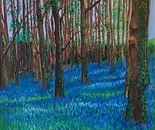
The field of Blue Bells in far away woods, Oil on canvas
sold.
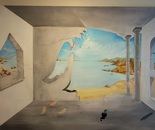 “Metamorphoses of an Angel (1996)”
Metamorphism of an Angel
Oil on Canvas | Originally Created 1996 | Restored 2025
Price: £7500.00
The Narrative
Metamorphism of an Angel is a study of presence through absence. Rather than depicting a celestial figure in a literal sense, the work captures the "event" of a divine departure. A jagged breach in the center of a confined room reveals the silhouette of an angel’s wing—a violent yet beautiful exit that leads to the infinite horizon of the Mediterranean. Through the use of floating feathers, the weight of a single fruit, and the silence of a hanging lyre, the painting explores the tension between the physical world we inhabit and the ethereal realm we sense just beyond the walls.
The Journey & Provenance
This piece holds a significant place in my body of work as my first large-scale oil painting. Its history is inextricably linked to my friendship with the late Lucia Bosé, the iconic visionary who founded the Museo de los Ángeles in Turégano, Spain. For over two decades, this painting was a part of that unique collection, living among a sanctuary of angelic forms curated by Lucia herself.
Following the museum’s closure during the global pandemic and the passing of Lucia Bosé, the painting began its long journey back to my studio. Time and travel had left their mark on the canvas; it returned to me damaged and weary.
The Restoration (A Second Metamorphism)
In a rare dialogue between my current self and the artist I was in 1996, I undertook a total restoration of the work. This was more than a repair; it was a rebirth. I engineered a new, robust internal framework to support the massive canvas and meticulously repainted the entire composition. This process allowed me to infuse the original vision with decades of matured technique and the emotional weight of the painting's homecoming.
Today, Metamorphism of an Angel stands as a "living" work—a bridge between 20th-century Surrealism and a modern story of resilience.
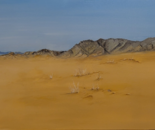
The Memory of Comfort
Oil on Canvas
Price:£620.00
The Narrative
The Memory of Comfort captures a moment of monumental yearning. A vast, reclining figure has become integrated into the landscape, forming the contours of the distant mountains. In his eternal, face-down rest, all that his subconscious can conjure is a singular vision: a place to sit. Tucked in the foreground, isolated by light and shadow, is the tiny domestic chair of his dreams. It is an object of profound simplicity and memory.
Symbolism and Style
This painting investigates the relationship between the enduring landscape and the fleeting objects of human desire. The "hidden" figure of the titan—whose body defines the very geology of the desert—represents a state of being that is both monumental and inert. The chair, a stark presence in the bottom-left corner, acts as a dream-object, a visualization of a subconscious longing for rest and domesticity. By using a "paranoiac-critical" approach, the work rewards the viewer's close observation, transforming a seemingly barren desert into a psychological portrait of a sleeping giant.
This piece explores the concept that even when we are inert or vast, our deepest desires remain simple and human, made visible in a landscape that has both forgotten and preserved them.
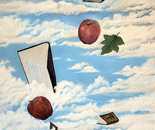
Falling Grace: Oil on canvas
Price: £495.00+frame included
creates a profound paradox. While 'Grace' typically implies a weightless, divine uplift, 'Falling' suggests a descent or a loss of control. The painting captures a slow-motion surrender, where the very icons that ground human belief systems have lost their tethering to the earth. The serene blue of the sky contrasts with the chaotic tumble of the objects, suggesting that there is a certain peace found in the act of letting go.
Falling Grace" is a compelling surrealist oil painting that explores the intersection of spirituality, knowledge, and the loss of gravity.
The composition features a vibrant blue sky filled with ethereal white clouds, through which various symbolic objects descend toward a distant, earthy horizon.
The Narrative
The Falling Grace is a profound exploration of the intersection between divine revelation and natural law. Set against a luminous, ethereal sky, sacred texts—including the Bible and the Torah—descend toward the earthly realm. From the pages of the central, most prominent book, Hebrew letters emerge to form the Tetragrammaton, the sacred name of God, manifesting the "Word" as a physical presence in the atmosphere.
Gaia’s Subconscious
(Mother Earth)
Oil on Canvas
Sold
The Narrative
Gaia’s Subconscious is an intricate meditation on the interconnectedness of spirit, nature, and human civilization. The composition utilizes a vertical narrative to present a "layered" reality, moving from the celestial to the subterranean. In the heavens, two ancient, interlocking trees arch toward one another, framing a "negative space" in the clouds that reveals the serene face of Gaia—the personification of Mother Earth—watching over the world she inhabits.
Symbolism and Structure
The painting challenges the viewer’s perception of the surface world. Beneath the forest floor, nestled within the earth's crust and sheltered by massive root systems, lies a densely packed village. This subterranean civilization suggests that humanity is not a separate entity from nature, but a fundamental part of its "subconscious" architecture.
The humans here are depicted as the hidden dreams or thoughts of the Earth itself.
Furthering the surrealist tension, a corner of the landscape at the bottom-left peels back like a veil, revealing a mysterious blue void beneath. This visual "rupture" serves as a reminder that the physical reality we perceive is merely one layer of a much deeper, more complex existence. The work invites the viewer to look beyond the visible forest and recognize the living, dreaming spirit that supports all life.
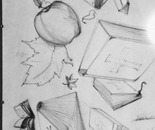 “Floating Pages & Autumn Echoes”
Narrative:
In this dreamlike illustration, the artist invites us into a world where time, memory, and stories float freely. The apple — an age-old symbol of knowledge — is suspended among open books and autumn leaves, suggesting a dance between the seasons of life and the stories we carry. Each floating page represents chapters of experience, while the leaves hint at the passage of time and the natural cycle of growth and release.
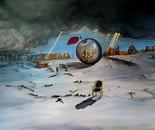 “The forbidden Glassapple for Elias”
In the cold, grey expanse of the desolate landscape, where the cracked earth stretches to a horizon dotted with the fractured ribs of long-forgotten civilizations, time itself seems to have paused, holding its breath.

 “Floating Tree”
 “Blue Bells ”
 “The Memory of Comfort”
 “Falling Grace”
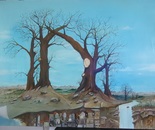 “Mother Earth”