
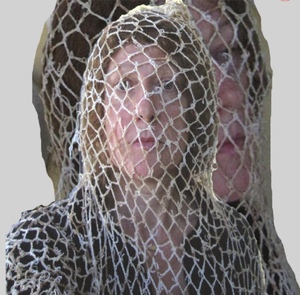
Location: Germany
Renate Helene Schweizer – The Art of Humanity
Portrait of an Artist Between Ecology, Social Sculpture, and Global Dialogue
At a time when museums, biennials, and art institutions around the world are increasingly seeking artistic positions that not only address ecological responsibility, social participation, and global interconnectedness but actively embody them, the work of Renate Helene Schweizer appears remarkably relevant. Her artistic research began long before concepts such as sustainability, circular economy, care, participation, and socially engaged practice became established terms within the international art world.
For more than four decades, Schweizer has worked at the intersection of visual art, performance, theatre, publishing, and civic engagement. Her practice combines aesthetic fragility with political urgency, developing from an apparently modest material—the used tea bag—a comprehensive artistic language of global significance.
From Theatre to Ecological Art Practice
Schweizer’s artistic journey began in the late 1970s with studies in puppet and figure theatre in Stuttgart, Munich, and Bochum. Together with fellow artists, she co-founded the Kartofler Figurentheater, which soon gained international recognition through appearances at festivals including FIDENA and the European Puppet Theatre Festival in Hong Kong.
She later studied Fine Arts at the Arts Institute of Boston in the United States and expanded her interdisciplinary research through studies at the European Graduate School in Switzerland. Artist residencies in India, Romania, Bulgaria, Hungary, Italy, the United States, and Switzerland further shaped her international perspective.
The connection between performing and visual arts remains evident throughout her practice. Schweizer’s installations are not static objects; they are experiential environments, stages for social encounter, and frameworks for human interaction.
The Tea Bag as a Global Archive
A decisive turning point occurred during an artist residency in New Delhi in 2005–06. There, Schweizer began collecting and transforming used tea bags as artistic material. From this seemingly simple observation emerged one of the most consistent long-term ecological research practices within contemporary German art.
Tea connects continents, religions, generations, and social communities. Schweizer recognized in it a symbol of global interdependence. Thousands of tea bags collected from around the world have been transformed into installations, objects, garments, paper works, sculptures, and participatory networks.
Today, this practice can be understood as an early form of ecological artistic research—predating the widespread institutional embrace of zero-waste strategies and circular material systems.
Artistic Position
Schweizer’s oeuvre encompasses:
Her work is distinguished by a unique material aesthetic. The patina of used tea bags evokes ancient manuscripts, archives, and historical documents. The material becomes a carrier of memory, migration, trade, spirituality, and cultural identity.
Today, Schweizer is regarded as one of the early pioneers of ecologically oriented artistic practice in Germany.
Publishing and Curatorial Activities
Alongside her visual art practice, Schweizer has worked extensively as a writer, organizer, and curator.
Within GEDOK Karlsruhe, she organized readings, exhibitions, and interdisciplinary art projects. From 2005 to 2013, she served as a specialist advisor for digital media, video, and photography.
Her artistic writings, statements, and public interventions connect ecological concerns with democracy, human rights, and cultural diversity. Recent projects such as DemokraTEA-Time exemplify this commitment.
International Collaborations
Collaboration across cultural boundaries is a defining characteristic of Schweizer’s work.
Her partnerships include:
Particular attention has recently been given to Call and Response, a collaborative artist book developed together with Los Angeles-based artist Berenice Fernandez. Exploring themes of loss, memory, and global interconnectedness, the project was presented at the Startup Art Fair Venice Beach in 2026.
Major Works
Come to the Table – An Invitation to All Nations and Religions
Since 2006, Schweizer has developed this long-term participatory project, connecting people from diverse backgrounds through the shared ritual of drinking tea. It stands among the earliest socially engaged works in her practice.
World Citizen Network (WeltenBürgerNetz)
A continuously evolving network made from tea bag strings, created through the participation of people from different generations, nations, and faiths. The work visualizes global relationships and understands community as an actively shaped process.
World Citizen World (WeltenBürgerWelt)
This monumental installation is considered a key work within Schweizer’s oeuvre. Created in 2019 in the crypt of the Protestant City Church of Karlsruhe, it became a walk-in space of humanity that symbolically transcends religious, cultural, and social boundaries. Art historian Dr. Carola Muysers described the installation as both a Gesamtkunstwerk and a retrospective of Schweizer’s artistic practice.
DemokraTEA-Time
Marking the twentieth anniversary of her tea-based art practice, Schweizer presented this exhibition in 2026. Addressing democracy, responsibility, and cultural diversity, the project combines art, dialogue, storytelling, and civic participation.
International Exhibitions and Biennials
Schweizer’s work has been presented in numerous international contexts, including:
Her presence extends far beyond the German art context, connecting paper art, ecological art, and social practice through an international network.
Awards and Recognition
Among her most significant distinctions are:
A Position for the Present
Renate Helene Schweizer belongs to a generation of artists whose work is only now becoming fully visible in its broader significance. While contemporary discourse increasingly revolves around sustainability, care, democracy, social sculpture, and global responsibility, she has been working on precisely these issues for decades.
Her art does not merely depict community—it produces community.
Her installations are not objects about the world—they are models for alternative ways of living together.
In this sense, her work appears today not as a marginal position within art history but rather as an early anticipation of the questions that increasingly define international contemporary art in the twenty-first century.
As art historian Dr. Carola Muysers aptly observed: Schweizer’s art does not merely speak of humanity—it gives it.
"Art is every single of my heartbeats"Renate Helene Schweizer is a free intermodal fine Eco artist.
Living and working within the arts since her childhood,
Art as an act of beauty, peace, and responsibility for the ecological footprint of the art.
2 dimentional works: material painting, mixed media,
3 dimentional work: installations, masks, sculptures
- national and international exhibitions and art-projects.
See more:
website: http://www.renate-schweizer.net
@artports:
https://www.artports.com/kuenstler-detail.php?kunr=349&name=Schweizer&vorname=Renate
https://m.youtube.com/user/RenateSchweizer
find her on facebook: https://www.facebook.com/RenateSchweizerArtist
https://vimeo.com/renateschweizer
Publications & catalogues:
https://issuu.com/renateschweizerart
Since 2005 I use old used teabags from all over the world as my basic art-material.
In contemporary art and an visuell fine artist I have to be responsible for resources and health of the earth as the source of all nature and beings.
I am aware and responsible for my ecological footprint, and that's why I am working with old used material since my beginning art-life in my childhood, always creating new treasures out of old trash stuff. This Portfolio is showing the basic material from using old tried teabags
That's how the teabagpapers look after opening the teabags and put out the teaplants
Here I am working with the teabagpaper, creating a huge installation with 12500 single teabagpapersheets
12500 teabags for the installation "Weltenbürgerdecke" at the exhibition "Wahlheimat", 2009, HfG | ZKM Karlsruhe, Germany
10 years ago I began the artproject, "Come to the dinner - an invitation to all religions and nations" and the "world-citizen blanket" with collected used tea bags as basic material .... What is the philosophical background of this artproject? How did it start? Who supplies the tea bags? Where is the artproject today ... "The beginning ... the way ... the development .. the current state ... Is art from tea bags art at all? ... make your own sense on the spot ..
Seit 10 Jahren "Kommt zu Tisch - eine Einladung an alle Religionen und Nationen" und die "Weltenbürgerdecke" aus gesammelten Teebeuteln.... Wie kam es dazu? Wer liefert die Teebeutel? Wo steht das Kunstprojekt heute ..." Der Anfang... der Weg... die Entwicklung.. der aktuelle Stand... Ist Kunst aus Teebeuteln überhaupt Kunst? ....
"Weltenbürgerdecke" -Installation
Part oft the installation "Weltenbürgerdecke" in the running exhibition "Akten und andere Hinterlassenschaften", Kunstverein Graz, Regensburg, Germany
different souls in my breast.. how can they come together... ?
dealing with the conlict of women in some parts of the world today
Sculptures made of old used teabags
sculpture made of old used teabags
size 120 x 80 X 80
sculpture made of old used teabags
size: 120 x 60x60
year: 2016
material: old used teabags
size: 120 x 60x 60
year: 2016
material: old used teabags
size: 120x 140x 120
year: 2016
material: old used teabags
size: 120 x 80x 80
year: 2016
- "Weltenbürgerdecke"
- "Kommt zu Tisch - eine Einladung an alle Religionen und Nationen"
- "Der Tisch ist gedeckt"
- "WeltenBürgerWelt"
Installationen
https://issuu.com/renateschweizerart/docs/installationen
https://issuu.com/renateschweizerart/docs/installation_gg3000neu
Raum-Installation, Ausstellung "Werke der Nachhaltigkeit" Projektraum Group Global 3000, G3000, Berlin
Installation im Raum, Group Global 3000, Berlin, 2017
Raum-Installation, Ausstellung "Werke der Nachhaltigkeit" Projektraum Group Global 3000, G3000, Berlin
material; teabagpaper -
objekt mask
part of the installation "WeltenBuergerWelt"
WeltenBuergerWelt
WeltenBuergerWelt
WeltenBuergerWelt
My wearable eco-fashion made of old used teabags
at the annual Hanji Paper fashion sho in Jeonju, South Korea
wearable eco paper-art made with used 600 single teabagpaper-sheets at Hanji paper fashion show in Jeonju, South Korea, 2007
wearable eco paper-art made with used single teabagpaper-sheets at Hanji paper fashion show in Jeonju, South Korea
wearable eco paper-art made with single teabagpaper-sheets at Hanji paper fashion show in Jeonju, South Korea, 2018
wearable eco paper-art made with used 600 single teabagpaper-sheets at Hanji paper fashion show in Jeonju, South Korea, 2007
 “Hommage to my beloved sister”
wearable eco paper-art made with used teabags and single teabagpaper-sheets at Hanji paper fashion show in Jeonju, South Korea, 2020
 “Hommage to my beloved sister”
screenshot wearable eco paper-art made with used teabags and single teabagpaper-sheets at Hanji paper fashion show in Jeonju, South Korea, 2020 https://www.youtube.com/watch?v=rPrQ-XjVCmQ
 “Hommage to my beloved sister”
screenshot wearable eco paper-art made with used teabags and single teabagpaper-sheets at Hanji paper fashion show in Jeonju, South Korea, 2020 https://www.youtube.com/watch?v=rPrQ-XjVCmQ
Hanji Paper Fashion 2020 screenshot wearable eco paper-art made with used teabags and single teabagpaper-sheets at Hanji paper fashion show in Jeonju, South Korea, 2020 https://www.youtube.com/watch?v=rPrQ-XjVCmQ
My last home" is dealing with existential questions that have not only arisen due to the spread of the corona virus and the imposed contact restrictions, curfews, "prohibitions on practicing" professional activity as an artist and art educator ln the last 2 years. Through the temporary withdrawal of her livelihood, she became existential confronted with the meaning of her being, the finiteness of her life and the questions "How do I want to die?" "
This resulted in the works "My Last Dwelling" and "My Bucket List". She works on her "Shroud" in progress. "Renate Schweizer is one of the "eco-artists of the first generation", Dr. Carola Muysers, art historian Berlin." "The climate crisis no longer allows a single felling of trees. Not even for coffins. The Free State of Bavaria has lifted the coffin obligation on AM 2021. Since then, burials may also be carried out in a shroud. As an artist in_responsibility, I would like to make a fair contribution to compliance with the 1.5°C limit even after my death and I want to be buried in my "shroud". But not in Bavaria" "My last dwelling" simultaneously addresses the increasing gentrification of homes and the loss of home that drive many people into homelessness and despair (to the point of suicide)....
materialpainting made during an artist in residence in Budapest, Hungary.
basic-material: used teabagpapers, paper, natural seeds, tea, strings
Material: different used dry teabags, teabagpapers
presented at the 5 th paper biennial in Israel, 2022
Shroud in progress
material: teabag-papers
technique: sewing
end- size: 436 x 110 like the "Turin Shroud"

 “Teabags in Budapest, collected from Julianne Clifford”
 “Coloured teabagsheets”
 “working with teabags”
 “12500 teabags”
 “Transformations”
 “Weltenbürgerdecke”
 “Weltenbürgerdecke”
 “Catched and lost ”
 “catched and lost”
 “catched and lost ”
 “woman in conflict”
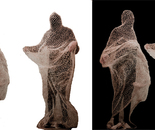 “catched souls ”
 “a planet for mother earth ”
 “a planet for mother earth”
 “a planet for mother earth ”
 “InnerOut”
 “InnerOut”
 “WeltenBürgerWelt”
 “WeltenBürgerWelt”
 “secrets in paper”
 “The gnome”
 “WeltenBuergerWelt”
 “WeltenBuergerWelt”
 “WeltenBuergerWelt”
 “WeltenBuergerWelt”
 “Kimono”
 “red dress for my niece”
 “for the new times”
 “Kimono ”
 “Hanji Paper Fashion 2020”
 “friends needed”
 “my bucket-list”
 “my last dwelling”
 “Shroud in progress”