
Location: Spain
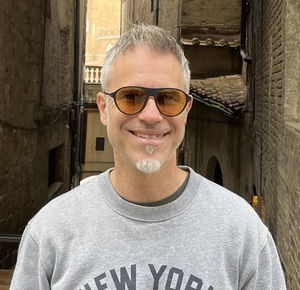
Born in a small town in northeastern Spain, Alex Carr discovered his passion for art at an early age, using vibrant colors and bold forms to express himself. Facing severe hip dysplasia from birth, which limited his mobility, he found solace in creativity, turning to art as both an escape and a means of communication. In the 1990s and early 2000s, Alex lived in New York City, where he exhibited his work and developed Geocubist Surrealism, an innovative style that merges cubist fragmentation with surrealism, incorporating geometric and circular forms to explore psychological, emotional, and societal themes. His art invites viewers to navigate the subconscious, blending structure with fluidity to reflect the complexity of human experience. Now, back in his hometown, Alex continues to push the boundaries of Geocubist Surrealism, using his work to challenge perception and provoke thought. His journey—from overcoming physical limitations to exhibiting internationally—embodies the transformative power of resilience and creativity. Through his art, he encourages viewers to explore the depth and intricacies of the human mind and the world around them.
Alex Carr combines the geometric fragmentation of Geocubism with the dreamlike, illogical imagery of Surrealism, resulting in works that are both visually striking and intellectually stimulating.
He uses geometric form to create landscapes, figures, and objects that are both recognizable and strangely distorted.
In his works, he explores the subconscious mind and the realms of dreams and the irrational, blurring the lines between reality and fantasy.
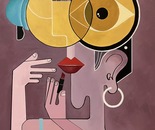
“whatever” (acrylic on canvas 60×80)
Whatever is a striking, surrealist-inspired portrait built from bold geometric forms, unexpected proportions, and a deliberately fragmented sense of perspective. The painting presents a stylized figure in profile, dominated by enormous overlapping golden-yellow eyes. One eye appears almost like a circular mask, while the other contains a deep black pupil and concentric forms, giving the face an uncanny, dreamlike quality.
The figure’s skin is rendered in muted mauve and dusty pink tones, set against a similarly mauve background that makes the brighter yellows, turquoise, reds, and blues stand out. Turquoise shapes frame the head like exaggerated hair or headphones, while thin black and white contours divide the face into almost architectural sections.
The composition becomes particularly expressive around the hands. Two elongated pink hands reach toward the face and mouth—one seeming to hold or gesture with a lipstick-like object—creating a sense of self-observation, vanity, or theatrical performance. The red lips are sharply simplified into a graphic, almost emblematic shape.
A large ear with a white hoop earring occupies the right side, contrasting with the enormous eyes and giving the figure a deliberately disproportionate, collage-like anatomy. At the bottom, blue-and-white vertical stripes introduce another pattern, while a long diagonal arm cuts dramatically across the composition.
What makes the painting especially interesting is the tension between beauty and absurdity. The polished geometric shapes, strong outlines, and harmonious palette give it the appearance of a carefully constructed fashion illustration, while the distorted anatomy and oversized features make the subject feel detached, playful, and slightly alien.
The title “Whatever” works beautifully with that attitude. It suggests indifference—a shrug at conventional beauty, proportion, identity, or even the need for the viewer to make everything “make sense.” The painting seems to say: Here I am. Look at me if you want. Whatever.
Overall, it feels fashion-forward, surreal, playful, feminine, and deliberately unconcerned with realism.
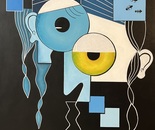
“The Labor Of Staying” (mixed media on canvas, 80 × 60 cm)
The Labor Of Staying is a mixed-media geocubist surrealist work that explores the difficult, deliberate process of rebuilding a relationship after turmoil. Rather than presenting reconciliation as something effortless or romantic, the painting treats staying as a form of construction, patience, and ongoing labor.
Two fragmented, abstracted figures occupy the centre of the composition, their forms overlapping and partially merging with one another. Their exaggerated eyes and ears transform perception into a central theme: to remain with someone requires not only seeing them again, but learning how to look and listen differently after what has happened. The large circular eye-like forms suggest vulnerability and heightened awareness, while the ears emphasize the necessity of hearing what was previously unheard.
The architectural geometry surrounding the figures evokes a structure under reconstruction. Sharp blue planes, white linear divisions, overlapping blocks and unfinished forms resemble fragments of a building being assembled piece by piece. This architecture becomes a metaphor for the relationship itself: something that has been damaged cannot simply return to its original state; it must be rebuilt into something new. The visible seams and irregular connections acknowledge that the reconstruction remains imperfect.
The recurring blue and yellow create an emotional tension between coolness and warmth. Blue dominates much of the work, suggesting distance, introspection and emotional restraint, while the intense yellow within the central circular form introduces warmth, life and the possibility of renewal. The contrast suggests that intimacy can coexist with uncertainty.
The small ants appearing within the architectural imagery reinforce the idea of labour. Their presence can be read as a surreal enlargement of the invisible work required to maintain a bond: small, repetitive actions that may appear insignificant individually but become meaningful through accumulation. They echo the human figures below, suggesting that rebuilding a relationship is itself a kind of collective construction.
The long, thread-like forms descending from the ears and figures introduce another layer of meaning. They resemble nerves, roots, wires or threads connecting separate parts of a structure. Their winding paths imply that connection is rarely straight or simple; it bends, tangles, breaks and reconnects. At the bottom, the unfinished outlined form feels particularly significant: a structure that has not yet been filled in, suggesting that the future of the relationship remains something being actively made rather than something already resolved.
Through its combination of geometric architecture, fragmented anatomy, surreal symbolism and collage-like textures, The Labor Of Staying turns an intimate emotional experience into a landscape of construction. The work proposes that love after turmoil is not defined by returning to what existed before, but by accepting the work of creating a different structure together.
“Staying is not the absence of rupture; it is the labor of rebuilding after it.”

 “Whatever”
 “The Labor Of Staying”