
Location: Romania
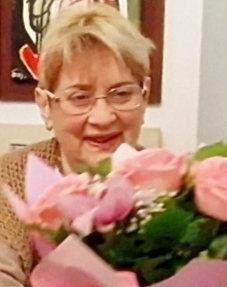
S -a născut la 5 noiembrie 1951, la Lugoj, judeţul Timiş.
A absolvit Liceul Iulia Hașdeu din Lugoj.
A absolvit Facultatea de Arte Plastice din Timişoara.
Este membră a Uniunii Artiștilor Plastici din România filială Timișoara (secția pictură) din 1980, debutul ca artist plastic profesionist fiind făcut în 1974 .
A fost profesor universitar la Facultatea de Design a Universității ,,Tibiscus”, iar în 2005 a titlul de Doctor în Arte Vizuale ( cu tema „ Tensiuni și energii vitale în pictura modernă „ ).
Activează ca grafician, pictor și designer . Până în prezent a participat la mai mult de 450 de manifestări expoziționale, dintre care 46 de expoziții personale în România, Germania, Ungaria și Grecia, precum și la numeroase concursuri internaționale, expoziții de grup în străinătate și în țară, expoziții republicane, județene.
A fost distinsă cu premii în 1985, 1987, iar în 1994 a primit Premiul pentru Pictură al Uniunii Artiştilor Plastici din România.
Are lucrări în colecții de stat: Grecia, România, Spania; şi în colecţii particulare : Elveţia, Franţa, Germania, Grecia, Italia, fosta Yugoslavie, Norvegia, Olanda, România, Spania, Suedia, SUA, Ungaria, Marea Britanie .
Este menționată în publicații de specialitate din țară și străinătate, ea însăși fiind autoarea unor articole științifice, a unor lucrări cu caracter didactic în domeniul designului vestimentar, sau a unor lucrări de teorie a artei: Introducere în stilismul vestimentar (2004); Tensiuni și energii vitale în pictura modernă
(2005); Paşi spre designul vestimentar
(2005, 2009); Un demers artistic de autodefinire (2007) .
Adresa : str. Carei nr. 28, sc. B, ap. 9 – 300646 Timişoara, România; tel. gloată.
0040744255782.
My works from recent years are inspired by the rhythms and structures found in the three natural kingdoms, with interest directed toward the energies generated by the living element. At times, there are allusions to elements from nature, but here they become new, autonomous forms with new meanings, within new structures. This large body of work is entitled “INTUITIVE STRUCTURES.”
In my painting, the pulsating energies of the organic oppose the immobility of the inorganic, creating tension between dynamic and static, leaving room for a form of dialogue. Gestural visual forms are placed in antithesis with others that are almost geometric, clear, even rigid. All forms contain pulses of energy that animate them.
I aim for these works to capture both the vital force and the sensitivity of life, as well as the establishment of a balance equally developed in symmetry and asymmetry—a state of anguish, but also of hope. Forms are created and dissolved. Planes intersect. Line and patch, in their dialogue, achieve a rational–affective balance. The curved line suggests the living element, the straight line refers to the inorganic, and broken lines convey agitation. The space of the image is composed of planes and forms that incorporate a spiritual movement.
There is much rigor and tension in these works, which, however, do not aim to overwhelm the system. It seems that abstract art, in its process of essentialization, is more direct in conveying the relationship between painting and idea, offering more possibilities for expressing subtle states.
The format of these works was square or vertically oriented rectangle. The format itself conveys emotional tension. This choice persisted until the emergence, in my own work, of spatial configurations, which have irregular, diverse forms resulting from the interpenetration of formative planes.
Tensions are created by each visual element. Within volumes, dynamic energies unite, moving the point toward the line, the line toward the surface, and the surface toward spatial dimension.
In my works of recent years, both formal and technical renewal has occurred. I introduced collage into painting, and three-dimensional spatial insertions dominate the visual units. I use unconventional lightweight materials (cardboard, paper, string, wood, etc.), making the works materially polyform. The transition has been made from objectification to spiritualization. These are the “SPATIAL CONFIGURATIONS”—dynamic compositional developments that still reveal the perceptual structures from which they originated. The abstract preserves the memory of the initial reality’s structures. The opposition between these two worlds generates new tensions.
The works attempt to move beyond conventional limits of genre and material. The images are subtly polemical, yet graphic, pictorial, and sometimes sculptural structures coexist harmoniously. They possess an abstract lyricism with bursts of vital energy. Energies and tensions dominate the whole. Forms are either emerging or in the process of becoming. The highly flexible drawing is sovereign. The synthesis of line and color patch creates balanced visual units, while energies derived from biological and vegetal rhythms generate spatial complexities.
Nevertheless, freedom in artistic thinking has guided me toward these new plastic achievements.
I have attempted to place these works—these spatial configurations—within the urban fabric of Timișoara. I analyzed the structural lines of new architecture and sought new expressive-plastic appearances for buildings. Where correspondences were found between architectural composition and my works, I introduced graphic-pictorial rhythms into architectural forms, proposing a dialogue, establishing stylistic continuity and a spatio-temporal unity. Thus, the building does not interrupt the rhythm or movement of the city; it does not isolate, but filters and intensifies life.
The three-dimensional spatial configurations (pictorial reliefs) that I place within architectural structures are dominated by energies and tensions, by rhythms that release vital force into active images.
In fact, a subtle process of self-definition has accompanied me throughout my entire artistic activity.
Și în această lucrare ca și în celelalte din acest ciclu, structurile picturale dialoghează cu grafismul. Expresivitatea maximă, ca rezultat al contrastelor folosite și forța sunt trăsăturile de bază.

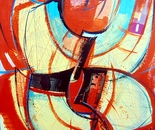 “STRUCTURI”