
Location: United States
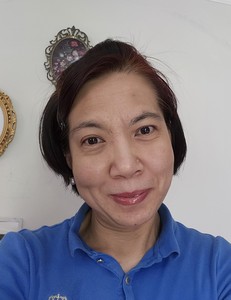
Maxine Xu was born in Beijing China to a well-educated family. Maxine started to learn Chinese Calligraphy
at the age of 8 which gave her good foundation in the later Chinese brush
painting at the age of 10. In 1997, she
came to United States and furthered her studies in Oklahoma City University and
successfully received her Master Degree in 1999.
Maxine Xu has always had a passion and devotion to painting. Her area of expertise is painting flowers,
fruits and birds while taking special pride in Han Chi(汉螭龙) This
ancient Chinese mythical creature holds deep personal significance for her,
embodying prosperity, good fortune, happiness, and completeness. Han Chi, a
magical image originating from ancient Chinese jade that has been buried
underground for millennia, is believed to possess an undying spirit. The
profound symbolism and rich history of Han Chi deeply resonate with her, making
it a central and recurring subject in her body of work.
Maxine’s art also frequently incorporates elements inspired by
rare Chinese vases, ancient door knockers and Tang Sancai further bridging the
past with the present. For her Han Chi series, she has hidden a piece of calligraphy character in her painting waiting for viewers to dig out.
Maxine creates her own style in her
painting. She uses both Traditional
Chinese color and Western Acrylic colors for her painting. It is a kind of creation and it works out great. Her works are welcomed by art lovers
worldwide. The wonder of discovery is presented in each of her brush paintings -
traditional yet fresh, and always gentle, graceful, and magical.
Maxine Xu has participated in the following Art exhibits and
activities in US and abroad for the past 16 years:
12/1/2025 – Certificate of Artistic Achievement acquired from
Luxembourg Art Prize 2025
11/7/2025 – 11/17/2025 22nd Globalart International Art Festival
2025, Globalart gallery, Noicattaro, Bari, Italy (Sea Tower)
11/9/2025 – Solo exhibition of entitled "Roots and
Metamorphosis", Globalart gallery, Noicattaro, Bari, Italy (Sea Tower)
11/3/2025 – Article titled Ancient
traditional Chinese art lives on in the contemporary works of Chinese-American
artist Maxine Xu published on Milano
Post
10/31/2025 – 12/31/2025 “Haunted Histories” online 3D
exhibition by Artflow Alliance
10/1 /2025 – Art Works published on ANIMA MUNDI ACADEMIA Art
Magazine Issue 17
8/25/2025 – Member of Globalart Gallery Bari, Italy
7/26/2025 – 8/1/2025 Mega Art Gallery, “In Search of Beauty”
Venice, Italy
7/1/2025 – 8/30/2025 “Beneath the Surface” online 3D exhibition
(Recognition of outstanding Award) by Artflow Alliance
5/29/2025 – Member of Mega Art Gallery Italy
12/1/2024 – Art Works published on the Global Art Times magazine
09/08/2024 – 61st Annual Juried Exhibition 2024 Sumi-e Society of
America
08/03/2024 – Houston International Origami & Art Festival
06/01/2023 – 07/01/2023 Chinese American Museum DC, Washington, DC
(Sumi-e Society of America National Exhibition 60th Annual Juried Exhibition)
03/01/2023 – Member of Sumi-e Society of America, Inc.
04/23/2022 – Houston Art Society (HAS) Spring Exhibition (won the second-place
award)
04/06/2013 – West Houston Chinese Church 22nd Anniversary “New
Life in Christ” Art Exhibition
12/17/2011 –Zen Art Gallery - Art Never Looked So Good
05/16/2011 – Art Institute of Houston APAHA (Asian/Pacific
American Heritage Association) Art Show (May 16, 2011- June 9, 2011)
04/24/2011 – West Houston Chinese Church 20th Anniversary “New
Life in Christ” Art Exhibition
02/14/2011 – Zen Art Gallery
– Chinese New Year Celebration Art Show
01/22/2011 – Zen Art Gallery Grand Opening Exhibit
12/04/2010 – Salt and Light Association Arts and Crafts donation
to Cancer Support Network (CSN)
09/11/2010 – Hilton Art Exhibit
07/04/2010 – Artworks
Donation Exhibit to C.A.R.E. Organization
01/30/2010 – N.A.G. Weekend
Art Gallery Exhibition
07/04/2009 –Artworks Donation
Exhibit to C.A.R.E. Organization
The Han Dynasty, about 2200 years ago, was truly a golden age of Chinese culture. It was a time of great growth and wealth, when art, literature, and technology all thrived. This era is especially known for its amazing jade carvings. During this period, jade carving reached a new level of skill and meaning. Han jade pieces are not only beautiful, they also show us a lot about the beliefs, social order, and art of that time.
My paintings carry stories and connect to this heritage. I see them as a dialogue—a meeting between the deep traditions of Chinese art and the energy of modern creativity. Through my style, I explore themes that link ancient wisdom with today’s world. A big inspiration for me is the Han Chi (汉螭⻰). I paint these magical monsters, and I name them Han Chi, Han means Han Dynasty in China which is around 2200 years ago. Chi is a Chi-dragon, also the second son (龙九子,螭吻居其二) of nine sons of dragon. The Chi has the form of a four-legged, long-tailed reptile.
I use symbols in my own way, inspired by the natural beauty around me. My goal is to create art that catches the eye while encouraging people to think about culture, history, and human inner strength.
In Eternal Love, fire and spirit intertwine. The painting draws the viewer into a luminous vortex—a glowing, almost celestial mandala where energy, emotion, and sacred geometry converge.
The bold orange outer diamond shaped ring radiates warmth and vitality. It’s a blaze of life, love, passion—expressed not as chaos, but as a structured and protective aura. This fiery halo isn’t wild; it encircles and safeguards, as if love itself is the force keeping everything centered.
At the heart, the purple pattern design pulses like a living symbol. Ornate, abstract, and flowing, it suggests figures or energies—dancing, merging, and moving as one. The central white space forms a subtle oval—like an untouched core, an open soul, or even a sacred womb. It’s the stillness within motion, the eye of the emotional storm.
Scattered across the surface are silver leaf, like cosmic seeds or stars—tiny blessings or fragments of memory orbiting the main form. They break the symmetry just enough to remind us: love, while eternal, is also full of mystery and imperfection.
This painting is not just about passion. It’s about devotion. It speaks to the kind of love that surrounds, transforms, and never dies. Even when unspoken, even when abstract—it is felt. Fully.
The artist did this painting early this year which she got the feeling from a jade auction in Hong Kong. This chicken heart pendant (It is a piece of jade buried under ground for more than 2,000 years ago in Han Dynasty) was auctioned for HK$1,386,000 at Christies' private auction show.
A Chinese jade chicken heart pendant from the Han Dynasty is a shield-shaped or heart-shaped pendant. These pendants were often placed in Han-dynasty burials of people of high rank. The pendant features a coiled Han Chi in an openwork design and was likely used as a pendant or ornament.
The artist wants to express the eternal love for the soul mates which this painting will attract positive energies to the audience.
The artist got inspiration from this Three Kui dragons (夔; pinyin: kuí; or one-legged dragon) jade ring which is now in Hebei Museum, China. Translucent carved round yellow jade pendant with a diameter of 6.4 cm. It was unearthed from the No. 1 tomb of the State of Zhongshan in the Warring States period, located in Hebei, China. It is made from a round jade piece with translucent carvings, semi-transparent, featuring a circular ring at the center. The outer contour of the ring is carved with three identical Kui dragons. The Kui dragons have bent single horns, round eyes, slightly open mouths, upwardly curved upper jaws, inwardly hooked lower lips, arched waists, drooping tails, and curled tail tips. The three dragons have arched necks turning back, arched backs, and uplifted tails, displaying vibrant life.
The artist’s painting carries a strong sense of harmony between tradition and expression. The artist uses ginkgo leaves to express endurance, peace and long life, contrasts with the structured patterns, adding softness and life. As you may see, there are three ancient Chinese Royal longevity symbols which the artist had added to this painting and let them swirl around the three Kui dragon jade ring, to bring triple effect of prosperity, good fortune and eternity to the viewers.
The background in warm golden tones radiates a sense of timelessness and reverence. Gold has historically been associated with the sacred, the eternal, and prosperity, and here it seems to cradle all the elements into one cohesive universe.
A vivid blend of deep blues and fiery red flowers, Flame and Flow capture the tension between calm and energy. The soft diffusion of ink and pigment evokes a sense of fluidity, impermanence, and balance. This work speaks to the cyclical dance between stillness and spark, chaos and calm. Like nature itself.
Autumn unfolds as a vibrant yet contemplative composition where deep umber, rust red, and amber tones mingle with inky blacks and soft yellows. The pigments appear to drift and merge like fallen leaves stirred by a gentle breeze, forming an organic, almost cloud-like structure at the heart of the piece. Over this atmospheric field, fine gold lines trace the outlines of chrysanthemums, bamboo, and other seasonal flora, their graceful forms emerging from the abstract background with quiet elegance.
The interplay between the free-flowing watercolor washes and the precise golden contours gives the work a sense of balance — between chaos and order, nature’s wildness and human contemplation. The flowers, rendered in pale white and gold, seem to shimmer against the muted paper, symbolizing endurance and purity amid the fading warmth of autumn.
At the lower left, the artist’s red seal and signature add a traditional note, grounding the piece in East Asian artistic heritage while the expressive abstraction keeps it contemporary. The composition evokes the transience of beauty, the gentle decay that comes with time, and the golden stillness of nature preparing for rest.
This painting captures the meeting of two energies — calm and fire, water and bloom. Using the language of Chinese brush painting, it composes a circle of life and balance. The vermilion flowers rise with warmth and vitality, their color breathing like sunlight at dawn. The blue answers with serenity, fluid as drifting clouds or rippling water.
The brushwork moves freely yet deliberately, each stroke holding both spontaneity and control — the essence of Chinese painting. Ink and pigment merge in soft transitions, echoing the natural flow of qi (energy) through all living things.
Though the palette is simple, the contrast of blue and vermilion evokes an eternal rhythm: yin and yang, earth and sky, stillness and motion. It’s a quiet conversation between colors — one that feels alive, harmonious, and timeless.

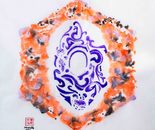 “Eternal Love ”
 “Triple Effect ”
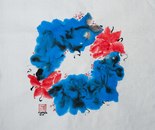 “Flame and Flow ”
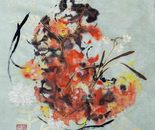 “Autumn”
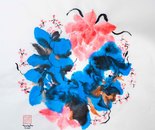 “Ethereal Bloom ”
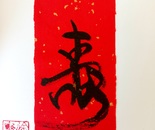 “Longevity”