
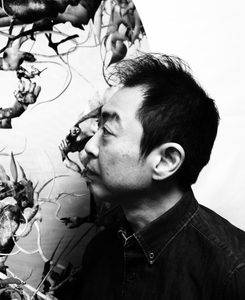
Location: Japan
I'm an artist in japan.
I’m mainly creating digital collage works.
★Please see my website for detail of my works.
https://www.gutchee.com/
★Various characters will appear in my digital artworks.
I introduce a part of it in instagram.
Please search with usernames for "takayoshi_6".
About the details of this work: https://www.gutchee.com/cw_01.htm
pigment-based inkjet print on synthetic fiber cloth, synthetic resin, wood panel
※2 piece multi panel, mounted on wood panels.
total:35×72 1/2 inches (89.4×184cm), 35×35 inches (89.4×89.4cm) each
ED --/6
 “Vivid Planet - Blue Warped moon”
statement
I create digital collage pieces with the concept of making the invisible visible.
The pieces are made using randomly created materials such as drawings, and combining them with different materials, connecting them visually into a single form.
With this process, I add images from my internal world, my thoughts, and my emotions to discover fresh, new shapes that do not exist in reality, and use them all in
the atypically shaped characters that appear in my works.
The theme of my works is the dynamism of life, and the amplification of my thoughts and emotions adds story-like characteristics to the still, digital images, which
make one feel the shift to and from each scene.
Every character is based on a familiar plant or animal, while at the same time is flexible, rich in variety, and highly rigid.
Unlike the traditional spiritual and occult images of Asia or the anti-naturalist expressions of the West, the atypical forms I use have been influenced by
the Choju Jinbutsu Giga(Animal-person Caricatures of East Asia in the mid-12th century), which were drawn in between the twelfth and thirteenth centuries in Japan,
and the eighteenth century artist Jakuchu ITO (Japanese painter of the mid-Edo period, 18C), especially their comical expressions, and flat, precise depictions, with the addition
of slightly over exaggerated facial expressions and movements, which give the characters presence and compatibility with their surroundings.
I go further and aim to make images that give a different impression when seen close and seen at a distance, for a multiplex of visual nuance and impact,
by constructing the entirety of each piece like a metacollage, that combines several such characters.
Further, the forms of the plants that appear in all of my works also heal us, and at times threaten us by becoming natural disasters, and so become self-conflicting symbols.
The structural harmony of the entirety and the pieces of each piece is based on the Buddhist philosophy of life, the way that the macrocosm of the universe and
the microcosm of human existence interact, is another important element of my work.
Most of my work is output digitally onto cloth and attached to wood panels covered in white coating, which heightens the development of the color, and some are printed
onto paper or put onto acrylic mountings.
I propose a variety of flexible exhibiting styles, with some works having the proportions of traditional Eastern works such as hanging scrolls or fusuma-e, some use
a multi-panel style reminiscent of the screen layout of the vertically long fusuma-e, with images lined up one after the next, and multi-panel hybrid types, where even
one piece could be exhibited on its own.
 “Vivid Planet - Flying eagle and snake”
statement
I create digital collage pieces with the concept of making the invisible visible.
The pieces are made using randomly created materials such as drawings, and combining them with different materials, connecting them visually into a single form.
With this process, I add images from my internal world, my thoughts, and my emotions to discover fresh, new shapes that do not exist in reality, and use them all in
the atypically shaped characters that appear in my works.
The theme of my works is the dynamism of life, and the amplification of my thoughts and emotions adds story-like characteristics to the still, digital images, which
make one feel the shift to and from each scene.
Every character is based on a familiar plant or animal, while at the same time is flexible, rich in variety, and highly rigid.
Unlike the traditional spiritual and occult images of Asia or the anti-naturalist expressions of the West, the atypical forms I use have been influenced by
the Choju Jinbutsu Giga(Animal-person Caricatures of East Asia in the mid-12th century), which were drawn in between the twelfth and thirteenth centuries in Japan,
and the eighteenth century artist Jakuchu ITO (Japanese painter of the mid-Edo period, 18C), especially their comical expressions, and flat, precise depictions, with the addition
of slightly over exaggerated facial expressions and movements, which give the characters presence and compatibility with their surroundings.
I go further and aim to make images that give a different impression when seen close and seen at a distance, for a multiplex of visual nuance and impact,
by constructing the entirety of each piece like a metacollage, that combines several such characters.
Further, the forms of the plants that appear in all of my works also heal us, and at times threaten us by becoming natural disasters, and so become self-conflicting symbols.
The structural harmony of the entirety and the pieces of each piece is based on the Buddhist philosophy of life, the way that the macrocosm of the universe and
the microcosm of human existence interact, is another important element of my work.
Most of my work is output digitally onto cloth and attached to wood panels covered in white coating, which heightens the development of the color, and some are printed
onto paper or put onto acrylic mountings.
I propose a variety of flexible exhibiting styles, with some works having the proportions of traditional Eastern works such as hanging scrolls or fusuma-e, some use
a multi-panel style reminiscent of the screen layout of the vertically long fusuma-e, with images lined up one after the next, and multi-panel hybrid types, where even
one piece could be exhibited on its own.
 “Vivid Planet - Talk with strange flowers”
statement
I create digital collage pieces with the concept of making the invisible visible.
The pieces are made using randomly created materials such as drawings, and combining them with different materials, connecting them visually into a single form.
With this process, I add images from my internal world, my thoughts, and my emotions to discover fresh, new shapes that do not exist in reality, and use them all in
the atypically shaped characters that appear in my works.
The theme of my works is the dynamism of life, and the amplification of my thoughts and emotions adds story-like characteristics to the still, digital images, which
make one feel the shift to and from each scene.
Every character is based on a familiar plant or animal, while at the same time is flexible, rich in variety, and highly rigid.
Unlike the traditional spiritual and occult images of Asia or the anti-naturalist expressions of the West, the atypical forms I use have been influenced by
the Choju Jinbutsu Giga(Animal-person Caricatures of East Asia in the mid-12th century), which were drawn in between the twelfth and thirteenth centuries in Japan,
and the eighteenth century artist Jakuchu ITO (Japanese painter of the mid-Edo period, 18C), especially their comical expressions, and flat, precise depictions, with the addition
of slightly over exaggerated facial expressions and movements, which give the characters presence and compatibility with their surroundings.
I go further and aim to make images that give a different impression when seen close and seen at a distance, for a multiplex of visual nuance and impact,
by constructing the entirety of each piece like a metacollage, that combines several such characters.
Further, the forms of the plants that appear in all of my works also heal us, and at times threaten us by becoming natural disasters, and so become self-conflicting symbols.
The structural harmony of the entirety and the pieces of each piece is based on the Buddhist philosophy of life, the way that the macrocosm of the universe and
the microcosm of human existence interact, is another important element of my work.
Most of my work is output digitally onto cloth and attached to wood panels covered in white coating, which heightens the development of the color, and some are printed
onto paper or put onto acrylic mountings.
I propose a variety of flexible exhibiting styles, with some works having the proportions of traditional Eastern works such as hanging scrolls or fusuma-e, some use
a multi-panel style reminiscent of the screen layout of the vertically long fusuma-e, with images lined up one after the next, and multi-panel hybrid types, where even
one piece could be exhibited on its own.
 “Vivid Planet - Silent conversation”
statement
I create digital collage pieces with the concept of making the invisible visible.
The pieces are made using randomly created materials such as drawings, and combining them with different materials, connecting them visually into a single form.
With this process, I add images from my internal world, my thoughts, and my emotions to discover fresh, new shapes that do not exist in reality, and use them all in
the atypically shaped characters that appear in my works.
The theme of my works is the dynamism of life, and the amplification of my thoughts and emotions adds story-like characteristics to the still, digital images, which
make one feel the shift to and from each scene.
Every character is based on a familiar plant or animal, while at the same time is flexible, rich in variety, and highly rigid.
Unlike the traditional spiritual and occult images of Asia or the anti-naturalist expressions of the West, the atypical forms I use have been influenced by
the Choju Jinbutsu Giga(Animal-person Caricatures of East Asia in the mid-12th century), which were drawn in between the twelfth and thirteenth centuries in Japan,
and the eighteenth century artist Jakuchu ITO (Japanese painter of the mid-Edo period, 18C), especially their comical expressions, and flat, precise depictions, with the addition
of slightly over exaggerated facial expressions and movements, which give the characters presence and compatibility with their surroundings.
I go further and aim to make images that give a different impression when seen close and seen at a distance, for a multiplex of visual nuance and impact,
by constructing the entirety of each piece like a metacollage, that combines several such characters.
Further, the forms of the plants that appear in all of my works also heal us, and at times threaten us by becoming natural disasters, and so become self-conflicting symbols.
The structural harmony of the entirety and the pieces of each piece is based on the Buddhist philosophy of life, the way that the macrocosm of the universe and
the microcosm of human existence interact, is another important element of my work.
Most of my work is output digitally onto cloth and attached to wood panels covered in white coating, which heightens the development of the color, and some are printed
onto paper or put onto acrylic mountings.
I propose a variety of flexible exhibiting styles, with some works having the proportions of traditional Eastern works such as hanging scrolls or fusuma-e, some use
a multi-panel style reminiscent of the screen layout of the vertically long fusuma-e, with images lined up one after the next, and multi-panel hybrid types, where even
one piece could be exhibited on its own.

 “Fertile Island 2 (L+R)”