
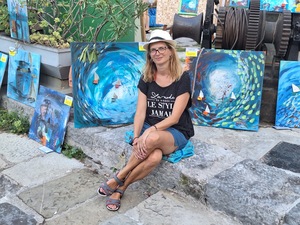
Location: Croatia
Born in Rijeka, Croatia, on February
11, 1975. After graduating from the First Croatian Sušak Gymnasium in Rijeka,
she continued her studies in economics. In her final year, she enrolled in the
Italian School of Fashion and Design Callegari. She completed a
postgraduate specialist study in Marketing Management at the Faculty of
Economics in Rijeka, as well as a group of pedagogical competence courses at
the Faculty of Humanities and Social Sciences in Osijek. She enrolled at ART
HOUSE – College of Visual Arts in Ljubljana, where she is currently attending
her third year, driven by the desire to finally become and establish herself as
a professional artist. Her passion for learning, knowledge, and experience
continues to grow; she participates in group exhibitions, Ex tempore
competitions… She shows interest in art therapy and attends a year-long
education for art therapy practitioners under psychologist Ana Božac, and takes
part in the Textile Biennial in Kranj, Slovenia – BIEN Kranj, within three-day
textile art workshops.
She explores the use and combination of various materials and techniques,
including cardboard, textiles, wire, and wood. She approaches fashion design
primarily as a critique of society, as each collection carries a story—from the
collection Recycled – Face Down!, which speaks about contemporary
society through the aesthetics of ugliness and won two awards from the Faculty
of Textile Technology in Zagreb in 1997, through the ecological theme The
Beauty of the Adriatic, to Human Virtues, where she combines
3D-printed brooches depicting Art Nouveau stuccoes of Rijeka with hand-sewn
creations. She also created Skirts for Men and Women, and the visual
installation project Rijeka’s Brhani – „Rijeka Wears – We Wear Rijeka“
as part of the Rijeka 2020 – European Capital of Culture program. She teaches
Fashion and Design at the Italian School Callegari in Rijeka.
Member of: Croatian Fine Arts Society (HLD), Zagreb, and Salvador Club,
Ljubljana.
My abstract boats emerge as symbolic vessels of inner journeys, carrying fragments of memory, emotion, and imagination across fluid, dreamlike spaces. Rather than depicting literal seascapes, they navigate through fields of color, texture, and gesture, becoming metaphors for movement, transition, and the quiet resilience of the human spirit. Each boat seems suspended between worlds—anchored in personal narrative yet open to universal interpretation—inviting the viewer to travel inward, to drift, to pause, and to reflect.
The interplay of layered surfaces and intuitive mark‑making gives the works a sense of depth and quiet tension, as if the boats are simultaneously searching and arriving. Their simplified forms act as visual anchors within the abstraction, grounding the composition while allowing the surrounding space to breathe and expand. In this way, the boats become emotional coordinates—points of orientation in a landscape shaped not by geography, but by feeling.

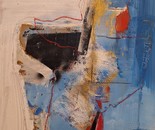 “Boat1”
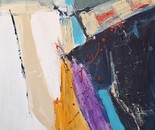 “Boat2”
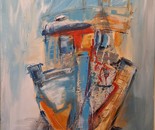 “Boat3”
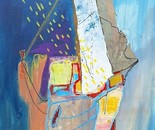 “Boat4”