
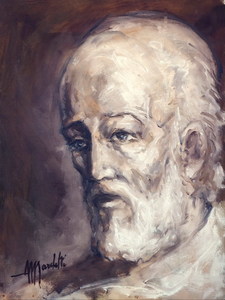
Location: Italy
Angelo Marchetti was born in Milan, Italy, on January 10, 1930, and registered the following day. His formative years unfolded in a city marked by post-war reconstruction and cultural tension, a context that deeply influenced his artistic development.
From an early age, he showed a strong inclination toward visual expression. Although initially directed toward commercial studies in line with his family’s expectations, he began working in his father’s small metalworking workshop, where he produced early engravings on sheet metal and experimented with sculptural interventions. A first encouragement came from a paternal uncle who gifted him his initial painting materials, allowing him to approach painting despite limited familial support for this path.
During adolescence and early adulthood, a growing conflict emerged between external expectations and personal vocation. This tension led him to reject a predefined professional trajectory and to pursue an independent artistic path, developing his language through direct engagement with material and experience.
At the end of the 1950s, Marchetti began frequenting Brera in Milan, a district that had become a central meeting point for artists and intellectuals. Although immersed in this environment, he maintained a marginal position, not adhering to any specific movement or school. His presence remained observational and autonomous, shaped by both choice and necessity.
To support himself, he worked as an interior designer, dividing his time between professional obligations and artistic research. In the early 1960s, he established a studio in Via Giovanni Raiberti in Milan, which became the center of his artistic activity until 1972. This space marked a decisive phase in his career, allowing him to consolidate his practice and engage with the artistic milieu of the time.
Over the years, his research gradually shifted toward an increasingly introspective direction. Painting, sculpture, and engraving on metal became instruments of inquiry rather than representation, aimed at exploring inner states and existential questions. His work developed as a continuous reflection on human condition, without definitive conclusions or resolved narratives.
Alongside his artistic activity, he developed an interest in esoteric studies. While never explicitly central in his production, these influences contributed to shaping a perception oriented toward deeper and less visible dimensions of experience.
Later in life, following a serious illness from which he recovered, Marchetti experienced a progressive withdrawal from public and social life. He did not pursue a conventional artistic career nor seek systematic visibility, maintaining instead an independent and secluded trajectory consistent with his introspective orientation.
Angelo Marchetti died in Milan on October 12, 2000, from acute myocardial infarction. He left behind a coherent body of work marked by a sustained tension between visible and invisible, form and inquiry, offering a practice that resists immediate interpretation and invites prolonged observation.
This portfolio presents selected works by Angelo Marchetti (Italy, 1930-2000), an Italian contemporary painter whose practice combines strong visual impact with symbolic and metaphysical depth.
His paintings are characterized by a distinctive figurative language, where essential forms, human figures, and constructed spaces become vehicles for emotional intensity and psychological resonance. Each work is conceived as a unique visual environment, balancing composition, color, and tension in a way that invites prolonged observation.
Marchetti’s works appeal to collectors interested in contemporary European painting that merges narrative suggestion with conceptual depth. The paintings are suitable for private collections seeking original works with a strong identity and lasting visual presence.
The portfolio reflects a coherent artistic trajectory in which painting is not only representation, but also a refined exploration of perception, inner states, and symbolic structure.
**Angelo Marchetti (1930–2000) — *Armageddon*, 1975**
Oil on canvas, 60 × 80 cm · Catalogue no. 1275 · Signed and dated upper right
The title names both the subject and the scale of ambition. This is not a battle scene — it is an ending of the world rendered in paint.
At the centre of the composition a white horse rears, radiant and almost spectral, its rider erect amid the chaos. Around them, a mass of dark horses and fallen figures writhes in the foreground, arms raised, bodies collapsing into one another, the boundary between human and animal dissolving in the tangle. To the left, the pale silhouette of a walled city — crenellated, distant, indifferent — stands against a sky already surrendered to darkness. The contrast is deliberate and unsparing: the lone luminous figure holds the centre not as a victor, but as a witness.
Marchetti builds the scene entirely in earths and burnt siennas, reserving his whites for the one figure that must be seen. The palette is that of dust and ash, of something ancient and irreversible. The paint is handled with urgency — broad, muscular strokes in the mass of bodies, precise and almost tender on the white horse — as if the painter too is caught inside the event he is depicting.
**Why this work matters to collectors:**
*Armageddon* belongs to the cycle of *Cavalli e Centauri*, widely considered the most powerful and iconographically distinctive series in Marchetti's output. A signed and dated canvas from 1975 — the artist's most intense decade — it demonstrates his full command of large-scale narrative painting, a rare ambition in the Italian art of that period outside the academic and institutional circuits Marchetti deliberately avoided.
An autograph work with secure, unbroken provenance, conserved in the artist's archive and fully documented, with catalogue number, measurements, technique and provenance traceable to the official archive.
Angelo Marchetti remains one of the most independent voices of twentieth-century Italian painting, whose corpus is now being studied and made accessible for the first time. Acquiring from the archive means entering this body of work at its source.
*Authenticated and documented at angelomarchetti.it ·
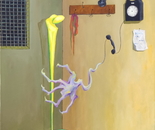
A mature phase in which Marchetti ceases to illustrate and begins to construct psychic landscapes: environments that do not exist in the visible world, yet which describe with millimetric precision inner states, conditions of being, and unresolved tensions between irreconcilable planes of reality. It is important to note that the artist explored themes connected to esotericism.
The core of the work is the anthropomorphic yellow figure standing at the center of the space. It is a body reduced to its essential form, stretched into a sinuous trunk culminating in a bowed head. That lowered head is the key to the entire composition. It is not the triumphant verticality of ascension, but rather the posture of surrender, of listening, of submission to event; the gesture of one bent under a weight and folded into itself.
The yellow, with a barely perceptible green shadow, does not convey the warmth of light or vital energy typically associated with yellow. The presence of green as a shadow element cools and immobilizes it. Here, yellow is assigned to a solitary, isolated, slender form that remains standing in a state of immobility, defined by a single supporting foot that allows no movement, no escape route, but only fixed stability while everything around it presses downward. The figure is alive, yet its life is a strained verticality rather than an exultation.
Around the body, at mid-height, an organic hand in violet and mauve tones takes shape, its nails reduced to spikes ready to grasp. Its ambiguity is deliberate: the gesture has begun but remains unfinished, suspended in a grip that does not close, in a threat that does not yet strike. The power of this image lies in its origin: the anthropomorphic hand is not autonomous but materializes as an extension of a telephone cable, as the visible substance of a voice. Here Marchetti performs a typically metaphysical operation: he gives body to the incorporeal, turns sound into matter, and transforms communication into a physical presence that surrounds and conditions the figure. What emerges from the receiver is not a word, but a psychic entity, a pressure, a hand attempting to hold.
The system on the right wall completes this dramaturgy of incommunicability. The heavy black telephone is the source from which the entire dynamic originates; the receiver, lifted and left suspended in emptiness, fixes the exact moment in which the conversation has been interrupted or remains awaiting a response that will never come. The sheet of paper with illegible notes reinforces this reading: something has been written, thought, preserved, yet remains hermetic and intransmissible. Knowledge is present in the space, but inaccessible.
The coat rack introduces the most brutal counterpoint of the work. From it hangs an empty sheath, a form analogous to the yellow figure yet emptied out, reduced to a casing. Its burnt sienna tone—light brown—communicates what is extinguished and withered, declaring its irreversible condition: it is what the central figure risks becoming, or what it may already have been. Marchetti thus places on the same canvas two states of the same being: the still-living form, tense in its bowed head, and the inert shell hanging on the wall like a discarded garment. Between them, space becomes the stage of an announced farewell.
The lower band confirms this downward tension. The green floor, broken and irregular in its residual outline, no longer provides stable support: it fractures, revealing beneath it a dark field of blacks, deep reds, and oxidized browns, a telluric emergence threatening from below the plane of existence. The yellow figure stands on a crumbling threshold. From above, the red ceiling compresses with its flat, unequivocal strip. Dark mass presses from below, chromatic pressure weighs from above, and the voice-hand envelops the figure in midair: in the middle, the figure resists, but its resistance is entirely played out along the edge of a bowed head. Marchetti’s art is not a sterile mirror of reality, but a gateway toward deeper dimensions of psyche and transcendence. In this canvas, that gateway is constructed with humble instruments: a slender body, a telephone, an empty casing, a collapsing floor yet it is a real gateway.
The work does not illustrate an allegory: it inhabits a liminal space in which the visible becomes a pretext for naming what ordinary language cannot reach. The bowed figure neither ascends nor falls: it remains suspended at the moment in which form questions its own destiny between the matter that holds it and the spirit that calls it. It is, in the strictest sense, metaphysical painting. (Marco Sofian – Milan, October 2005)
“The Greatest Event” is an oil on canvas painting by Angelo Marchetti. A work of contemporary Italian art that explores symbolism and metaphysical tension through an essential and visionary composition. The work is intended for collectors and art enthusiasts.
angelomarchetti.it
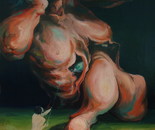
Angelo Marchetti (1930–2000) — Untitled, 1971
Oil on canvas, 120 × 80 cm · Catalogue no. 1331 · "Opere Nere" (Dark Period) series · Signed and dated lower right
A rare original oil from the artist's most sought-after cycle, the Opere Nere. Against a deep black ground, a colossal, anatomically transfigured figure unfolds in flesh tones, ochre and cold turquoise; at its feet, a small luminous child holds a thread that tethers the giant — a striking inversion of scale that has made the works of this period the most recognisable in Marchetti's output.
Why this work matters to collectors:
A signed and dated canvas from 1971, executed at the height of the painter's visionary maturity. Works from the Opere Nere series rarely appear, as the great majority remain held within the family estate. This is an autograph piece with secure, unbroken provenance, conserved in the artist's private archive and never previously offered.
Each work is fully documented and authenticated by the official Angelo Marchetti Archive (ADAAM), with archival catalogue number, recorded measurements, technique and provenance — essential guarantees of authenticity and a fully traceable history for any serious collection.
Angelo Marchetti remains one of the most independent and introspective voices of twentieth-century Italian painting: an artist deliberately apart from the market in his lifetime, whose corpus is now being studied, catalogued and made accessible for the first time.
Authenticated and documented at angelomarchetti.it
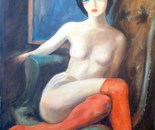
Angelo Marchetti (1930–2000) — Red Stockings, 1980
Oil on canvas, 100 × 70 cm · Catalogue no. 1338 · Signed upper left.
A refined female nude from Marchetti's full maturity. A young woman sits in an armchair in bottle-green tones, nude except for a pair of long red stockings that set the composition ablaze; the dark bob, the blue-shadowed gaze and the bright lips evoke the elegance of the années folles and the lesson of the great portraitists of the early twentieth century. The cold, pearly light of the flesh, set against the vermilion red of the stockings and the warm browns of the background, reveals the painter in his most sensual and controlled register.
Why this work matters to collectors:
A signed and dated canvas from 1980, executed in the artist's most mature season, in which the human figure achieves a rare balance between formal rigour and modern sensibility. The subject — the elegant, psychologically present nude — is among the most sought-after in Marchetti's output and rarely appears on the market.
An autograph work with secure, unbroken provenance, conserved in the artist's family private collection and fully documented and authenticated by the official Angelo Marchetti Archive (ADAAM), with catalogue number, measurements, technique and provenance: essential guarantees of authenticity and a fully traceable history for any serious collection.
Angelo Marchetti remains one of the most independent and introspective voices of twentieth-century Italian painting, whose corpus is now being studied, catalogued and made accessible for the first time.
Authenticated and documented at angelomarchetti.it

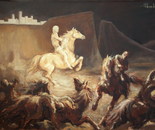 “Armageddon”
 “untitled”
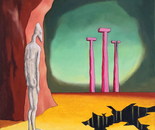 “The Greatest Event”
 “untitled”
 “red stockings (K1338)”