
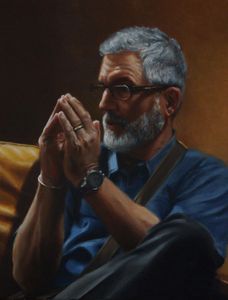
Location: United States
William Catling
Biography
From an early age, William Catling discovered a fascination with clay. On warm summer afternoons, he shaped bowls, cups, and teapots from purple-gray earth gathered from freshly cut trenches, inventing elaborate outdoor rituals that sparked his lifelong engagement with the material.
Catling’s early love of clay endured even as he pursued painting in his teenage years and later enrolled at San Francisco State University in the early 1970s, where he worked toward a Bachelor of Arts degree. A defining moment came during a required ceramics course with Professor Joe Hawley. At the class’s first critique, Hawley challenged students to move beyond producing functional objects and instead create work of personal significance, objects that tested the expressive and structural limits of the material. Taking this challenge to heart, Catling purchased 100 pounds of sculpture clay and committed himself fully to sculptural exploration.
The following semester, he studied under Stephen De Staebler, whose mentorship most profoundly shaped his artistic development. That mentorship grew into an apprenticeship, and in 1981 Catling entered the master’s program in sculpture under De Staebler’s guidance, beginning a decade of close study and collaboration.
From these formative years emerged a philosophy that continues to guide his practice:
Clay is alive. The role of the artist is to work in tune with the life of the
materials. The crack in the clay is a gift to be received. The kiln is like
Christmas, always rich with unexpected gifts. Humanity is bound by a
common spirit to be rejoiced with, mourned for and shared in. Advanced
technology can be dangerous, to be handled with gloves, saving the skin for
contact with things elemental in nature. The real work of the artist is always
in the studio. Leave politics and activism to the politicians and the activists.
Our art is the work of our lives. Don’t spend too much time in galleries and
museums, they can confuse your personal vision. Balance: stay healthy
inside and out of the studio. - William Catling
These principles inform both his studio work and his teaching. As a professor at Azusa Pacific University in Southern California, he brings decades of rigorous practice to the classroom, experience that includes mixing clay, making and moving monumental sculptures, transporting and installing exhibitions, and sustaining a disciplined and rigorous studio life.
Catling’s work has been influenced by significant figurative sculptors, including Stephen De Staebler, Alberto Giacometti, Robert Arneson, Manuel Neri, and Viola Frey. Within this lineage, he remains dedicated to the tradition of figurative sculpture as a life’s work, shaping clay into forms that reflect vulnerability, resilience, and the enduring complexities of the human experience.
“Navigating the Deep Pelagic”
This body of work explores how the horizontal and vertical interact; as they relate to birth and death, the spiritual and the physical, water and vapor, matter and spirit.
The boat forms hover in the horizontal liminal space between the fluidity of liquid and the intangibility of air; functioning as a kind of container for the human spirit.
These forms reflect the interior space humans occupy at the soul level, the deepest part of the self.
The boat form is symbolic of an internal journey, of silent prayer, of transitional spaces; quietly impacting the area around them or the viewer who comes close.
The usage of clay reinforces a connection to the earth and the way we are rooted to the land while the vessel form creates a way of navigating deep waters.
As a whole, the work creates a type of mapping where there are no landmarks, no place to anchor, and no way to know the way, without an upward gaze into the heavens.