

Location: United States
Mitchellville (Prince George's County) Maryland USA was a quintessential rural community first formally designated in or about 1878, although its settlement began as far back as the late 17th century. This collection of 30 watercolors presents watercolor renditions of selected late 1800s to mid-1900s Mitchellville landmarks hoping to capture and preserve for history the ethereal, dreamlike mood and feeling of a bucolic place and time long gone but not forgotten.
This image is a sample from this collection. If one imagines how a classic rural general store may have looked in 1940s and 1950s, the vision might well take the form of Shatenstein's located at the intersection of Mitchellville’s Enterprise and Woodmore Road with its bulk groceries, some dry goods, hardware, Lucky Strike cigarettes and chewing tobacco, pickled pigs feet, Royal Crown Cola, and penny candy.
For the full collection, follow instructions in my profile.
Upper Marlboro, Maryland, the county seat for Prince George's County, has spanned five centuries, from 1695 until the present, standing out as one of the oldest surviving European settlements in the United States. Upper Marlboro was known in earlier years as Marlborough Town, a period during which it was designated a port town, then later as Upper Marlborough to differentiate it from Lower Marlborough in Calvert County. Ultimately, its name was shortened to Upper Marlboro in the late 19th century for convenience.
This image is a sample from this collection. The Upper Marlboro Opera House is one of those landmarks that was almost lost to history. There is no drawing of the building, but a remaining artifact reveals that, on September 14, 1752, the Beggar's Opera was performed there. Not much is known about the building itself. The town historian suggested that the opera house may have been in a tobacco warehouse across the street from the current post office. Interestingly, the belief is that this opera house was the first in the nation featuring accompaniment by an orchestra/music. This is representative of Upper Marlboro's role as a cultural center in the 18th and 19th centuries.
For the full collection, follow instructions in my profile.
From the mid-1800s until today, Bowie, Maryland, evolved from a small railroad stop to the largest municipality in Prince George's County and one of Maryland's largest cities. It is particularly recognized for the 1960s Levitt & Sons Belair at Bowie development, the historic Belair Mansion (circa 1745), and as a former center for thoroughbred horse racing. But Bowie was, and is, so much more.
This image is a sample from this collection. The Bowie Train Station, founded in 1872, stands as a monument to the rail era that reshaped Maryland. Named after Governor Oden Bowie, the station transformed the rural settlement of Huntington into a bustling commercial hub for travelers. It originally served as a critical junction for the Baltimore and Potomac Railroad, linking Washington DC to the Pope's Creek branch which, in turn, stopped at Mullikin Station in Mitchellville as depicted in another of Steve’s collections. The original depot remains a preserved artifact of 19th-century infrastructure that connected rural farmers to expanding urban markets.
For the full collection, follow instructions in my profile.
Ocean City, Maryland felt like a summer home to Steve in his youth. Every year, his family would spend a week or two there, staying at one of the hotels right along the boardwalk. He remembers waking up early to the sound of the ocean, renting a bicycle to ride the boardwalk in the early morn, breathing in the fresh, salt air before the heat and crowds set in; walking the wooden boards at night with that special Ocean City excitement, eating Thrasher's French fries from a huge bucket (and sometimes unwittingly sharing them with the ever-present seagulls), smelling suntan lotion that permeated the summer air, and spending seemingly endless days on the beach. Ocean City began as a small fishing community in the late 1800s before growing into one of the East Coast’s most popular vacation destinations. The famous boardwalk, first built in 1902, became the heart of the town and still captures that classic beach-town feeling today. For Steve, Ocean City is more than a vacation spot -- it’s a place filled with memories, tradition, and summertime nostalgia of the 1950s and early 1960s.
Ocean City began as a quiet fishing village and seaside retreat in the late 1800s, growing rapidly after the Atlantic Hotel (featured in another watercolor) opened in 1875 and rail service arrived a few years later. At the turn of the century, hotel owners and workers laid sections planks of wood on the sand each morning so visitors could stroll comfortably, forming the first boardwalk. At night, the planks were removed and stacked away because the tides would otherwise wash them out to sea. A permanent promenade followed in 1910 and steadily expanded during the twentieth century. Storms, especially the devastating Ash Wednesday storm of 1962, repeatedly damaged the boards, but each rebuilding made the attraction larger and stronger. Today, the 2.5-mile boardwalk blends nostalgic amusements, shops, arcades, restaurants, and beaches, welcoming millions of visitors every summer while preserving the lively family atmosphere that has always defined Ocean City’s coastal identity.
For the full collection, follow instructions in my profile.
Like many places in the mid-twentieth century, Washington, DC's Maryland suburbs had their share of summer carnivals and fairs featuring amusement rides, games, food stands, entertainment, and family activities. They usually lasted for a week or two and were gone. Then there were the more permanent amusement parks that would typically open for the whole summer then close during the winter months. Two of those in the Maryland suburbs were Marshall Hall and Glen Echo. Marshall Hall was located on the Potomac River in Charles County, Maryland, about 20 miles south of Washington, DC. Glen Echo was in Montgomery County, Maryland, just northwest of Washington, DC, along the Potomac River near Cabin John. Steve frequented both of these parks in his youth and teenage years. Glen Echo was probably more special to him because it was larger and, importantly, he benefited from his mother’s many stories about her enjoyable days there in Glen Echo’s early years.
In the early 1950s, arriving at Glen Echo Park by streetcar was part of the adventure. As the trolley rolled through the leafy suburbs beside the Potomac River, families, couples, and groups of children eagerly watched for the park’s distinctive entrance. Stepping off the streetcar, visitors were greeted by colorful signs, the cheerful sounds of carousel music, and the excited chatter of summer crowds. Ahead stood the park’s iconic Spanish Ballroom and whimsical architecture, painted in bright colors that reflected the park’s Chautauqua-era roots. The scent of popcorn, cotton candy, and hot dogs drifted through the warm air. Beyond the gates, rides, games, picnic grounds, and dancing awaited. For many Washington-area residents, the streetcar ride to Glen Echo was a cherished summer tradition in itself.
For the full collection, follow instructions in my profile.
The Chesapeake Bay’s western shore beaches became popular recreational destinations in the late nineteenth and early twentieth centuries as steamboats and railroads made them accessible to visitors from Washington and Baltimore. Many shore communities developed specifically to attract summer tourists seeking relief from city heat. During their peak years from the 1890s through the 1960s, these beaches were bustling centers of family recreation. Visitors swam in the Bay, strolled boardwalks, and enjoyed dance halls and amusement parks. Although some resorts declined after the rise of automobile travel, they remain an important part of the Chesapeake region’s cultural and recreational history. Today, most of the former western shore beach resorts have been converted to residential communities, public parks, marinas, or natural conservation areas.
The Great Derby Roller Coaster was one of the signature thrills of Chesapeake Beach. By 1940, generations of visitors had already raced through its wooden curves overlooking the Chesapeake Bay. For a teenager, climbing into the open car was a mixture of excitement and nervous anticipation. The chain lift clicked steadily upward as the beach, boardwalk, and sparkling water spread out below. At the crest came a brief moment of silence before the train plunged down the first drop. Wind rushed past, hats needed holding, and laughter mixed with screams as the coaster sped through dips, turns, and hills. When the ride ended, most teenagers climbed right back into line, eager to experience the thrill again.
For the full collection, follow instructions in my profile.

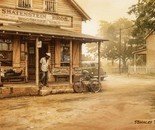 “Shatenstein's Store”
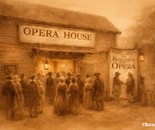 “Upper Marlboro Opera House”
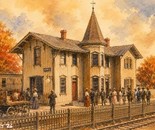 “Bowie Train Station”
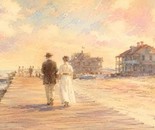 “Ocean City Boardwalk, 1928”
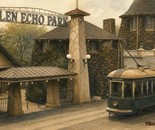 “Glen Echo Entrance”
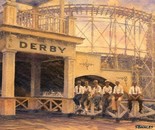 “Chesapeake Beach's The Great Derby”