
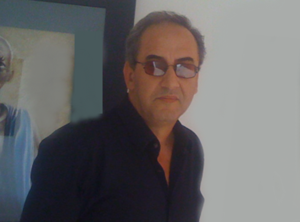
Location: Morocco
Abderrahmane Latrache was born in Taza, Morocco, and has always pursued a dual path between science and art.
Trained as a medical biologist at the Catholic University of Louvain in Belgium, he simultaneously studied fine arts in Brussels while attending workshops led by renowned Belgian pastel masters.
He became the first foreign artist admitted to the Société des Pastellistes de France, marking an important milestone in his artistic journey. His work was also featured in the Larousse Dictionary of Modern and Contemporary Artists (2004–2011).
During the early 2000s, Latrache gained international recognition through several exhibitions and awards, including:
2005
Silver Medal — International Fine Arts Salon of Perpignan, France
2004
City Prize — International Fine Arts Grand Prix of Nice, France
2003
Nice Matin Newspaper Prize — International Fine Arts Grand Prix of Nice, France
2004–2011
Featured in the Larousse Dictionary of Modern and Contemporary Artists
After a decade dedicated to medicine and professional responsibilities, he returned to painting with a renewed artistic vision—deeper, darker, and more introspective.
His contemporary work explores human emotion, silence, African identity, and psychological depth through figurative compositions that combine pastel, acrylic, and mixed media techniques.
Today, Abderrahmane Latrache lives and works in Morocco.
From the very beginning of my artistic journey, I embraced pastel as my preferred medium of expression — a technique that uniquely blends the immediacy of drawing with the sensual depth of painting."
Beneath the theatrical costume and painted face lies a quiet sense of fragility.
This work explores the contrast between performance and inner truth, revealing the loneliness often hidden behind appearances.
Wrapped in a sculptural white drapery, the figure embodies stillness, dignity, and quiet anticipation.
The urban symbols and fragmented typography in the background create a tension between timeless human presence and the restless rhythm of modern life.
Bathed in an almost ethereal light, a female figure appears to break free from the weight of the earthly world.
The white drapery, both a shelter and a restraint, dissolves into a radiant glow that evokes rebirth.
Her head lifted toward the sky expresses a longing for freedom, transcendence, and inner awakening.
The shadows and faded symbols in the background whisper of memories, wounds, and unanswered questions left behind.
The interplay of transparency, texture, and flowing paint drips reflects the fragility and resilience of the human spirit.
This work captures a suspended moment of transformation, where suffering is transfigured into light and hope.
Lost in a moment of quiet contemplation, the young woman seems to listen to the whispers of her inner world.
The soft shades of gray, white, and blue create an atmosphere of calmness and serenity.
The luminous drapery evokes purity, while the abstract textures suggest the traces of time and memory.
Her gaze turned away invites the viewer to imagine a personal story suspended between remembrance and hope.
The balance between realism and abstraction gives the work a poetic and timeless quality.
This painting celebrates the silent beauty of reflection and the quiet strength of the human spirit.
Shrouded beneath a delicate white veil, the figure emerges as both present and hidden, revealing strength through concealment.
The stretched fabric transforms the body into a landscape of tension, vulnerability, and quiet resilience.
Surrounded by bold abstract forms, the luminous silhouette becomes a focal point of contrast and mystery.
The absence of a visible face invites the viewer to look beyond identity and explore universal human emotions.
Light and shadow intertwine, creating a dialogue between exposure and protection, freedom and restraint.
This work is a meditation on the invisible self, reminding us that what remains hidden often carries the deepest truths.
Emerging from darkness, the figure stands at the threshold between shadow and illumination.
A radiant band of light cuts across the composition, symbolizing revelation, hope, and transformation.
The loose, sweeping brushstrokes dissolve the body into a luminous presence, blurring the line between matter and spirit.
With eyes gently closed, the subject appears suspended in a moment of introspection and inner peace.
The contrast between the deep black background and the ethereal whites creates a powerful sense of tension and harmony.
This work speaks of resilience, the quiet journey toward self-discovery, and the courage to step into the light.

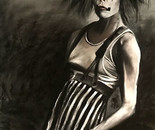 “Behind the Smile”
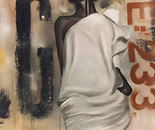 “Waiting”
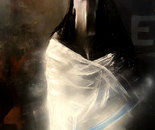 “Distress”
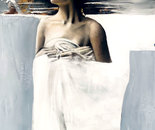 “Between Two Horizons”
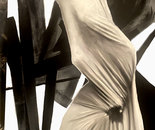 “Anonymous”
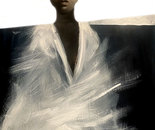 “Crossing the Light”