
Location: United States
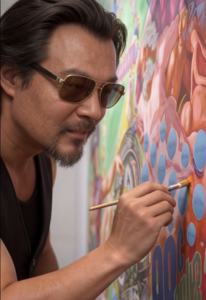
Bill Seet is a contemporary painter based in the San Francisco Bay Area whose practice examines the intersection of popular culture, art history, abstraction, and digital image-making. Working across acrylic and oil on canvas, self-generated computer graphics, and giclée prints, Seet explores how images are constructed, circulated, and transformed within contemporary visual culture.
Drawing from social media, art historical references, personal experience, and the visual language of systems and patterns, Seet recontextualizes familiar imagery through a process that moves between digital experimentation and traditional painting. His work often plays with the tension between representation and abstraction, order and disruption, and the historical language of painting and the rapidly evolving imagery of contemporary culture. Through this approach, Seet challenges conventional interpretations of pop art and art history while investigating how technology and contemporary media continue to shape the way we see and understand images.
Seet studied painting at San Francisco State University, where he worked under artists Bob Bechtel, Richard McLean, and Paul Pratchenko. His work has been exhibited at Exhibitionism Gallery, Pasquale Innetti, and Michelle Ellis Gallery, and is held in various private collections.
Seet is currently developing a new body of work examining the relationship between future aspirations and present direction. The project continues his ongoing investigation into identity, visual culture, technology, and the systems that influence both individual experience and contemporary image-making.
Digitally repainting the Hades and Proserpina statue, for me, is like reframing their myth of rebirth. I wanted the figures to exist in a space that feels unstable and constantly in transition. I stretched and distorted their bodies into elongated, brush-like forms, treating the figures less as solid marble bodies and more as something fluid that can be pulled apart and reconstructed. The missile popsicle introduces a contradiction between innocence and destruction: something playful and nostalgic becomes threatening, reflecting the tension between desire, death, and renewal within the myth. Behind the figures, a 1970s television static pattern creates another layer of disruption. The static acts as visual noise, placing an ancient story within a contemporary media landscape and suggesting how myths are transmitted, distorted, and given new meanings over time. Together, these elements allow me to imagine rebirth not as a clean transformation, but as something fragmented, uncomfortable, and constantly being remade.
I think of the painting as a kind of metaphorical washing machine: different colors, materials, symbols, and meanings are tossed together until their original identities begin to change. Like colorful clothes mixing in a wash, the boundaries between sacred and ordinary, luxury and consumption, tradition and contemporary culture become blurred. Royal Cola explores what happens when these separate worlds are stirred together and come out looking like something new.
Venus Redux reimagines the iconic figure of Venus from Botticelli’s The Birth of Venus and places her in a very different world. Instead of emerging from the sea surrounded by the beauty and mythology of the original painting, Venus stands in front of a chain-link fence—a familiar, everyday barrier that changes the way we see her.
With Venus Redux, I’m interested in what happens when an image we recognize as a symbol of beauty and perfection is taken apart and placed in a new context. The work brings together classical art, popular imagery, repetition, and digital manipulation to question how images of beauty are preserved, altered, and understood over time.
Rather than simply recreating Venus, I wanted to give her a new setting and let the surrounding imagery change her meaning. The result is a Venus caught somewhere between the past and the present—familiar, but no longer quite the same.

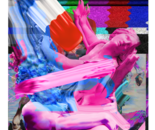 “Blame it on color TV”
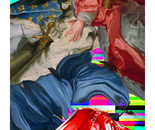 “Royal Coke”
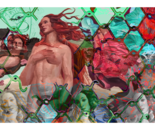 “Venus Redux”