
Location: Mexico
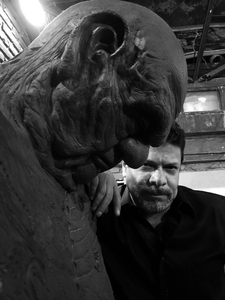
LVCCA (b. 1969, Mexico City) is a contemporary painter whose work investigates the psychological structures underlying the human condition. He lives and works in Mexico City.
His practice is rooted in a multidisciplinary formation that began in the early 1990s, combining formal training in painting with Roberto Roque and sculptural experience under Ricardo Ponzanelli, where he developed technical knowledge in bronze casting and participated in the production of monumental works. This dual foundation informs a material and structural approach to painting that remains central to his work.
Over the course of his career, LVCCA has presented more than 18 exhibitions, both in Mexico and internationally, including presentations in Spain, France, and Argentina. His work also extends into the public sphere, with permanent installations and murals in institutional contexts.
Following a prolonged hiatus, he resumed his artistic practice in 2020, marking a shift toward a more conceptually focused body of work. His recent production is developed under what he defines as Cognitive Surrealism, a term he uses to describe an approach that examines fragmentation, identity, and internal conflict through constructed visual systems.
Working primarily in oil on canvas, LVCCA develops compositions through processes of intervention, layering, and material accumulation. His figures—often altered or destabilized—operate as structural elements within a visual system that resists narrative closure. Rather than illustrating, the work establishes a field of tension that invites active interpretation.
His practice positions painting as a site of inquiry, where form, material, and image converge to address the instability of perception and the complexity of human experience.
VISUAL CATHARSIS: ART AS A REFLECTION OF THE COLLECTIVE SUBCONSCIOUS
By Antonio Sánchez. Director and Curator of 1819 Art Gallery
Art, in its capacity to reveal the invisible, confronts us with our own specters. In this pictorial series, the artist unfolds a visual language that transcends traditional figuration to delve into the fragmentation of the self. Echoing the dark surrealism of artists such as Zdzisław Beksiński and the psychic automatism of André Masson, these compositions do not merely illustrate scenes, but immerse the viewer in a space where the human, the organic, and the oneiric collide.
Here, bodies twist, faces disintegrate, and forms seem to crawl out of the subconscious into an uncertain materiality. Skin transforms into landscape; cracks and textures evoke the erosion of memory, while objects appear to have been extracted from a symbolic universe that defies rational logic. The work stands as a visual testimony of a psyche in crisis—a labyrinth where identity dissolves and consciousness becomes trapped in a hall of mirrors.
Painting becomes an act of dissection: each brushstroke functions as an incision into the flesh of reality, revealing not only what lies on the surface, but the deeper layers of the human psyche. The distorted and fragmented faces evoke the imagery of Francis Bacon, where the figure collapses into a contained scream—a reflection of existential anguish. The presence of decomposing anatomical elements suggests the inevitability of time and the fragility of the body, recalling the still lifes of Flemish Baroque painting, where memento mori emerges as an unavoidable constant.
The use of texture and painterly material reinforces this sense of transience. Skin becomes an eroded map shaped by the passage of time; cracks across bodies and objects act as remnants of a hidden history. Here, paint is not merely representational, but a battleground between the tangible and the ephemeral. Gold, which in medieval sacred art symbolized divinity, appears here as a trace of disintegration—as if the aura of the sacred had been contaminated by the decay of the contemporary world.
The symbolism within these works is rooted in the tradition of visionary art—one that seeks to open pathways to hidden dimensions. Elements such as the butterfly, the chameleon, and the presence of mutating anthropomorphic forms suggest constant metamorphosis, a transition between states of consciousness. The recurring presence of the eye as a central element evokes surveillance and self-awareness, recalling Michel Foucault’s concept of the panopticon: a structure of power in which the subject is constantly observed, leading to self-regulation.
The compositions are traversed by diagonal lines and directions in tension, as if the scene were on the verge of collapse. In this sense, the artist engages with the structure of the Baroque altarpiece, where theatricality and drama intensify the viewer’s emotional experience. The presence of exposed flesh and distorted faces also recalls the imagery of Matthias Grünewald’s altarpieces, where the body is presented in a heightened state of suffering—as a vehicle for redemption or condemnation.
However, unlike traditional religious art, where suffering is oriented toward transcendence, here it remains immanent: there is no redemption, only transformation. The human face, disfigured and mutable, confronts us with the impossibility of a fixed identity, echoing Jean-Paul Sartre’s reflections on existential anguish. Within this pictorial universe, being is not defined by what it is, but by what disintegrates in the process of becoming.
The objects that emerge within these works—musical instruments, weapons, fruit—belong to a system of signs in which meaning remains fluid. A trombone may function as a silent scream; a weapon may symbolize power or oppression; an apple may represent desire or corruption. Within this semiotic field, the artist compels us to look beyond the image and to interpret the work as an open system of shifting meanings.
From an aesthetic perspective, the chromatic palette reinforces the psychological impact of the series. Flesh tones and earthy hues refer to the materiality of the body, while contrasts with black and gold generate a sense of unsettling theatricality. This use of color and light recalls Caravaggio’s chiaroscuro, where illumination not only shapes form but intensifies the emotional charge of the scene.
Each painting functions as a threshold—an invitation to decipher the symbols of a pictorial language governed not by everyday logic, but by the grammar of dreams and memory. The city of the mind becomes the true protagonist of this series, its surface marked by scars—traces of a past that continues to pulse beneath.
Ultimately, these paintings operate as mirrors in which the viewer can recognize themselves—not as individuals, but as part of a collective unconscious. They are documents of transformation in process, affirming that identity is an ephemeral construct, and that the true essence of art lies not in the representation of reality, but in its capacity to reveal what remains hidden from plain sight.
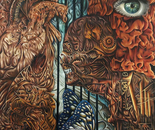
This work operates within contemporary surrealism as a focused exploration of identity under transformation. The fusion of flesh, mechanical elements, and organic forms presents a human figure in transition, where the boundaries between the biological and the technological begin to dissolve.
Through controlled use of light, texture, and structure, the image creates a tension between external influence and internal awareness. Elements such as the mechanical eye and natural growths suggest forces that reshape perception and identity, while the overall composition functions as a constructed mental space.
Rather than offering resolution, the work confronts the viewer with the instability of the self, pointing to a reality where identity is continuously redefined by forces that are both internal and external.
This work confronts perception through a direct exploration of transformation, identity, and the passage of time. Combining raw realism with surreal elements, it presents the human figure in a state of change, where fragmentation and exposed forms reflect vulnerability and the constant cycle of renewal.
The presence of the chameleon introduces the idea of adaptation, positioned over a central sphere that suggests a stable core beneath continuous transformation. Structural elements such as the striped background reinforce rhythm and temporality, while organic details point to ongoing metamorphosis.
Rather than offering a fixed meaning, the work captures a moment of transition, emphasizing the instability of identity and the inevitability of change as defining conditions of human existence.
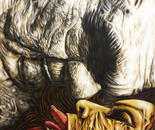
This work explores the human condition caught between instinct, desire, and identity. Through a surreal, dreamlike composition, it presents a fragmented face dissolving into organic textures, emphasizing the instability of the self and continuous transformation.
Sewn lips suggest enforced silence and repression, while the partially obscured female figure conveys vulnerability and ambiguity. The presence of the crow introduces a sense of vigilance between the conscious and unconscious.
Through contrasts of color, texture, and distorted forms, the piece constructs a tense visual field where the human and the inhuman coexist. Rather than offering resolution, it functions as a direct reflection on internal conflict, suppressed desire, and the shifting boundaries between reality and perception.
This work immerses the viewer in a dreamlike state where time and space dissolve and the unconscious takes control. A distorted, fragmented figure becomes a symbol of identity in crisis, dissolving into its surroundings and blurring the boundary between self and environment.
Emerging forms suggest projections of the subconscious—traces of suppressed thoughts and desires—while contrasts between warm flesh tones and cooler, ethereal elements create tension between the physical and the intangible.
Rather than a stable image, the piece functions as an introspective space, confronting the viewer with instability, desire, and the shifting limits between reality and perception.
This work explores the human condition caught between primal impulses and the complexities of desire and identity. A fragmented face dissolving into organic textures reflects the fragility of the self and its constant transformation.
Sewn lips suggest enforced silence and repression, while the partially obscured female figure conveys vulnerability and ambiguity. The presence of the crow introduces a sense of tension between the conscious and the unconscious.
Through contrasts of color, texture, and distorted forms, the piece constructs a visual field where the human and the inhuman coexist. It ultimately functions as a reflection on internal conflict, suppressed desire, and the unstable boundary between reality and imagination.
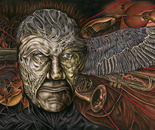
This work presents a focused exploration of the human condition as a field of internal conflict. A central face, rendered with almost sculptural density, conveys tension between introspection and psychological strain, emphasizing the weight of lived experience.
Contrasting elements structure the composition: the firearm introduces latent violence and instinct, while the wing suggests the possibility of transcendence. Together, they establish a duality between destruction and elevation, between the material and the aspirational.
In the background, musical instruments connected by linear structures evoke systems of connection—whether emotional, neural, or symbolic—while floating golden forms introduce a sense of distance between the human and the ideal.
Rather than resolving these tensions, the work sustains them, operating as a visual meditation on identity, conflict, and the forces that shape human existence.

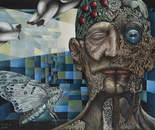 “DREAMS”
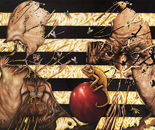 “MIRROR”
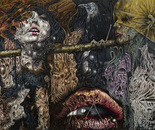 “BONFIRE OF THE VANITIES”
 “GLUTTONY AND LUST”
 “THE EYE OF THE UNCONSCIOUS”
 “CATHARSIS”