
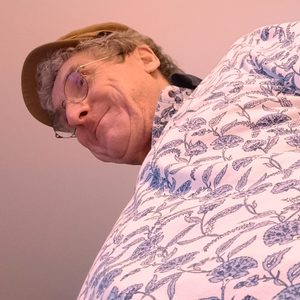
Location: France
Born
in 1957 in Antwerp, Belgium, Karel graduated from the Institut
Saint-Luc in Brussels and trained in engraving at the Académie Royale
des Beaux-Arts, where he obtained a certificate of passage « with
distinction. ».
Today, in France, he concentrates on writing about art history, producing audio guides and of course watercolors and engravings.
In France, as a member of the Fédération
nationale de l’estampe, he confirmed his technical mastery at Atelier63
and continued to perfect his skills in the Montreuil workshop of Danish
engraver Bo Halbirk.
It takes a lot of courage to overcome the fear to be “completely alone” while you walk a road nobody ever walked on. Everything starts by having a “spark” of imagination and forge it into paradoxical metaphors. As an example, the way I created my work Stairway to Heaven (color etching on zinc, image 3). It started with my examination of the fantastic Chinese landscape paintings. Going through pictures of Chinese landscapes, I realized some of these paintings were not pure imagination but based on landscapes that really existed. The most fascinating of them are certainly those of an area called “Yellow mountains.”
Now at that time, I was also unraveling the way the Flemish painter Joachim Patinir painted his landscapes, as objects for religious contemplation. In the latter’s painting, man is seen, as in Augustinian philosophy, as a pilgrim, who has to learn how to detach himself from earthly possessions, that attachment considered a source of evil. The pilgrim is at the crossroads. By his free will he has to decide, either to take the easy road downhill or the difficult road uphill where he will reach out by going through a small gate.
So in my etching, I “married” a landscape from this Flemish school (on the left) with a view of China’s Yellow mountain. Initially, I had left out the pilgrim, but by working on the landscape, the idea came back to my mind. To accentuate that the road downhill was the road to evil, I added an owl, in Flemish folk art a symbol of evil since able to see in the dark and to grab you in your weakness. So, as one of my friends says, “behind Karel’s works, there’s always a story,” but it is up to you to discover it !”
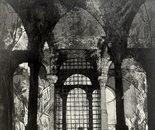 “The Coincidence of Opposites”
When I was recently in Milan to receive an art award, I visited the Pinacoteca Ambrosiana. There are beautiful paintings there, and the library is a leading repository for Da Vinci’s codices. But I also knew there was a crypt. I was deeply impressed by this almost Paleo-Christian monument. I discovered that dreadful cage reminiscent of Piranesi’s depictions of torture and prisons. In the center of that cage stands a painted plaster statue of the praying Charles Borromeo (well-known in Antwerp), bishop of Milan who was made a cardinal in 1560. Borromeo went to pray in that cage every week before a tombstone that is a replica of Christ’s in Jerusalem. What impressed me is how that man (whom I do not hold dear in my heart), as a clergyman, praying in a sort of double prison (cage + crypt), apparently felt spiritually completely free in God. A divine paradox,” Vereycken said.
“So that was my starting point. Hence the Cusian title ‘Coincidence of Opposites.’ I raised the vaults and made them more monumental. I also used varnish to imprint plant motifs, to enhance a spatial effect that is both open and yet enclosed. A bit of sleight of hand, but the magic was definitely there!”

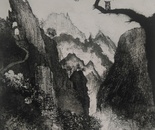 “Stairway to Heaven”
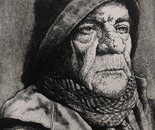 “Flemish Fisherman”
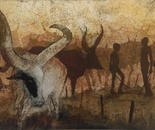 “Farmers of Sudan”
 “Gardens of Argenteuil”
 “View on the Thames, London 1902”