

Location: Germany
International online-Gallery since 2010
How an Artist Connects the World with Tea Bags
Renate Helene Schweizer
1. Introduction: Art from a Teacup
Imagine you’ve just finished a cup of tea. What do you do with the used tea bag?
Most likely, you throw it away. But what if I told you that an artist collects these small, ordinary tea bags and turns them into stunning works of art?
That’s exactly what the german artist Renate Helene Schweizer does. She’s an artist who transforms something of everyday as a used tea bag into huge blankets, delicate sculptures, and even clothing. Yet, her art is more than just beautiful — every single piece carries an important message: a message of peace, humanity, and connection among all people around the world.
Let’s discover her inspiring story together.
2. The Spark: An Idea Born from a Cup of Tea
Every great idea has a beginning — and for Renate Schweizer, it was a world-changing event that started it all: the terrorist attacks of September 11, 2001. These tragic events made her search for a peaceful way to connect people and religions. She wanted a material, a symbol that everyone could understand and that excluded no one.
She found the answer a few years later, in 2005, during an artist residency in New Delhi, India — over a cup of tea. That was her “aha moment.”
For the artist, the tea bag is much more than waste. It’s a symbol of humanity. Think of it this way: each used tea bag is uniquely stained and textured by the tea — no two are alike. The same is true for people: each of us is unique, shaped by our own experiences and stories. And when these individual tea bags are brought together, something new and greater emerges — a diverse community where everyone has their place.
This art project became deeply personal for her. Just two days after her first exhibition in 2006, her mother unexpectedly passed away. This profound loss gave her the strength and determination to make the project her life’s work, pursuing it with even greater passion and dedication.
But how does one transform a simple idea and a pile of old tea bags into a complex creative process that unites people all over the world?
3. From Waste to Artwork: How Tea Bag Art Comes to Life
Renate Schweizer is an eco-artist — a kind of magician who looks at what we call trash and sees a treasure waiting to be revealed. Nothing goes to waste!
In her case, she reuses almost every single part of a tea bag. Her process unfolds in three main steps:
Collecting – It all begins with the mail, turning people into co-artists. From all over Germany and the world — Australia, South Korea, North America, Russia, Poland, Israel, Scotland, Romania, Canada, and many more — people send Renate Schweizer their used tea bags. The act of collecting itself becomes a global community project.
Preparation – The arriving tea bags are carefully dried. Then the meticulous handwork begins: Schweizer gently separates each bag into its five parts — the smoothed paper, the little tag, the string, the tiny metal clip, and even the dried tea leaves.
Transformation – From these prepared materials, the actual artworks take shape — often with the help of many participants. The colored paper is sewn together into large blankets or installations, shaped into sculptures, or turned into wearable art. The strings become woven nets, and the tea leaves are used to form new figures.
This remarkable process forms the basis for some of her most famous projects — each spreading her message around the world.
4. A Network for the World: Renate’s Most Important Projects
Through her tea bag art, Renate Schweizer has launched several large-scale projects that invite people to participate and reflect. Here are three of her most significant works:
5. Art with a Message: Why She Does What She Does
Renate Schweizer sees herself as an “artist with responsibility.” To her, that’s more than just a title — it’s a life philosophy. She doesn’t want to create art only for herself in the studio; she wants to use it actively to make the world a little better. Her works invite us to reflect on social and ecological issues and to stand up for justice, peace, and compassion.
Her guiding belief can be summed up in one sentence that has become the motto of her artistic work:
“The highest form of art is humanity.”
The path hasn’t always been easy. Especially since 2013, she has felt the rise of hate and division in society, which has taken a toll on her. Yet what keeps her hopeful are the many people who continue to collect and send her their tea bags. These small gestures remind her that the desire for connection and community is stronger than hate and separation.
Her art is therefore more than a museum object — it’s an invitation to all of us to take part in creating a more humane and just world.
6. Conclusion: A Work of Art That Is Never Finished
The story of Renate Schweizer and her tea bag art shows how something great and meaningful can emerge from the smallest, most ordinary things. In her hands, a discarded tea bag becomes a symbol of humanity, and thousands of them together become a sign of global unity.
Her work, like humanity itself, is constantly growing, never truly finished, and depends on the contributions of many to remain strong. She leaves us with a hopeful thought that reminds us where everything begins:
“May the roots of this installation for a World Citizens’ World grow and flourish — in the crypt and everywhere — as places of humanity.”
Red. Kunst_aktuell, October, 2025
Artproject of Renate Helene Schweizer

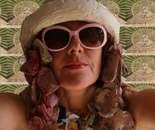 “Photo of the artist”