25.10.26
RENATE HELENE SCHWEIZER: THE WORLD IN A USED TEA BAG
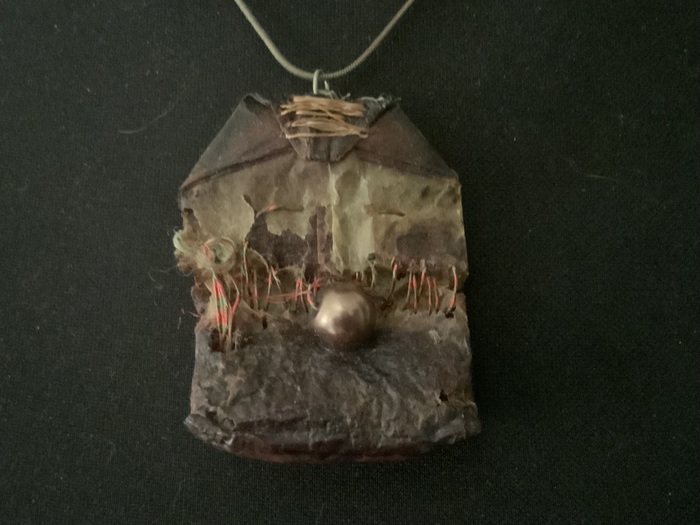
posted by PREVIEW.SÜDRenate Helene Schweizer: The World in a Used Tea Bag For more than four decades, Renate Helene Schweizer has developed an intermediale practice that brings together ecological material ethics, social sculpture, practices of remembrance, and global networking. Her central material—the used tea bag—is not understood as waste, but as a carrier of cultural biographies, social relationships, and political responsibility. [bbk-karlsruhe](https://bbk-karlsruhe.de/kuenstlerinnen/renate-helene-schweizer/) A Practice of Responsibility Schweizer describes herself as an “intermediale eco-artist in responsibility.” This term is more than a self-designation: it names an artistic principle in which aesthetic, ecological, social, and political questions are inseparable. Her works are appeals for humanity, peace, tolerance, and global connectedness—yet they are formulated not as moral messages, but through material, process, and encounter. [bbk-karlsruhe](https://bbk-karlsruhe.de/kuenstlerinnen/renate-helene-schweizer/) Her background helps explain this stance. Schweizer first studied puppet theatre in Stuttgart, Munich, and Bochum, founded the Kartofler Figurentheater in the early 1980s, and subsequently completed a master’s degree at the Arts Institute of Boston. The interplay of object, performance, narrative, and public space remains palpable in her later work: even her installations often retain something theatrical, ritualistic, and community-building. [bbk-karlsruhe](https://bbk-karlsruhe.de/kuenstlerinnen/renate-helene-schweizer/) The Tea Bag as Archive The decisive material turning point in her practice came in 2005, during an artist-in-residence stay in New Delhi. Since then, Schweizer has worked intensively with used tea bags, tea-bag strings, and their fragments. What may at first appear to be recycling is, in fact, a complex reinterpretation: the tea bag becomes a “global archive” of human interconnections. [globalartproject.wordpress](https://globalartproject.wordpress.com/) Tea connects continents, trade routes, classes, religions, generations, and everyday rituals. In Schweizer’s practice, the used tea bag therefore stores not only a personal trace of use, but also collective memory, cultural difference, and geopolitical dependencies. She transforms this unassuming material into large-scale installations, material paintings, sculptures, wearable art, and participatory networks. [bbk-karlsruhe](https://bbk-karlsruhe.de/kuenstlerinnen/renate-helene-schweizer/) From Object to Social Sculpture Schweizer’s work consistently moves from the individual object toward social relation. Projects such as *Come to the Table—An Invitation to All Religions and Nations*, *WeltenBürgerWelt* (*World Citizen World*), and the *WeltenBürgerNetz der GeNerATIONEN* (*World Citizens’ Network of Generations*) do not arise solely in the studio, but through collecting, sending, knotting, storytelling, and collective action. The artwork thus becomes a process in which people of different origins, generations, and life circumstances take part. [globalartproject.wordpress](https://globalartproject.wordpress.com/) This becomes especially clear in the *WeltenBürgerNetz*: people around the world join tea-bag strings together by hand. The resulting networks are at once fragile textile structures and images of social connectedness. They demonstrate that community cannot simply be assumed; it must be produced laboriously, carefully, and repeatedly. [globalartproject.wordpress](https://globalartproject.wordpress.com/) Ecology as Ethical Stance Schweizer’s ecological art is not decorative sustainability but ethically grounded. She asks not only how materials can be reused, but also what responsibility art assumes for resources, climate justice, housing, migration, peace, and human mortality. Her works therefore connect circular thinking with questions of democracy, care, and social cohesion. [globalartproject.wordpress](https://globalartproject.wordpress.com/) In the more recent works *Meine letzte Behausung* (*My Final Dwelling*) and *Leichentuch in progress* (*Shroud in Progress*), this stance becomes existential. Schweizer links the climate crisis with questions of dying, dwelling, and the loss of home. The burial shroud developed from tea-bag material thus becomes both a personal image of mortality and a critique of wasteful forms of burial and construction. [bbk-karlsruhe](https://bbk-karlsruhe.de/kuenstlerinnen/renate-helene-schweizer/) International Networks Schweizer’s practice is strongly transnational. Her works have been shown, among other places, in Germany, India, the United States, Switzerland, Romania, Hungary, and South Korea; since 2007, she has regularly participated in the Paper-Fashion-Show in Jeonju. In 2012, she took part in *dOCUMENTA(13)* with *Come to the Table*, in the context of the Critical Art Ensemble. [bbk-karlsruhe](https://bbk-karlsruhe.de/kuenstlerinnen/renate-helene-schweizer/) Her work also remains embedded in international dialogue today: in 2026, she was represented at the Startup Art Fair in Los Angeles with the artist’s book *Of Loss and Love: An Artifact for Friendship*, as part of *Call and Response*. Created through a transatlantic exchange, the work addresses grief, friendship, memory, and resilience in a book woven from tea-bag strings. [bbk-karlsruhe](https://bbk-karlsruhe.de/kuenstlerinnen/renate-helene-schweizer/) Contemporary Relevance Today, Schweizer’s practice appears less like a marginal position than an early anticipation of central debates in contemporary art: the material turn, social sculpture, participatory research, ecological justice, and transcultural networking. Her strength lies in addressing these themes not abstractly, but through a small, everyday material rich in traces of use. [globalartproject.wordpress](https://globalartproject.wordpress.com/) Her work reminds us that sustainability is not merely a technical question, but a cultural, emotional, and political one. In the used tea bag, Schweizer shows how relationships, memory, and responsibility can emerge from what has been discarded—and how art does not merely represent community, but actively brings it into being. [bbk-karlsruhe](https://bbk-karlsruhe.de/kuenstlerinnen/renate-helene-schweizer/) Conclusion: The Art of Connecting Renate Helene Schweizer’s artistic practice shows that ecology begins not with renunciation or purity, but with attentiveness: to what has been discarded, to traces of use, to people, and to the connections between them. In her work, the used tea bag is not a symbol of poverty or waste, but a small archive of the world—a material in which everyday life, trade, migration, ritual, memory, and responsibility converge. [bbk-karlsruhe](https://bbk-karlsruhe.de/kuenstlerinnen/renate-helene-schweizer/) Her art demonstrates that major social questions need not be addressed only in monumental forms. Precisely the small, fragile, and seemingly worthless can unfold political power when it is collected, shared, knotted, and placed in relation. In Schweizer’s networks of tea-bag strings, it becomes visible what social sculpture can mean today: not a finished utopia, but a shared, vulnerable, and ongoing form of action. [globalartproject.wordpress](https://globalartproject.wordpress.com/) Her works therefore speak with particular urgency in an age of climate crisis, war, migration, and growing polarization. They remind us that responsibility does not remain abstract; it begins in the concrete handling of material, space, and fellow human beings. Schweizer transforms what remains into neither nostalgic memory nor mere residue, but into a site of encounter—between generations, cultures, religions, and continents. [bbk-karlsruhe](https://bbk-karlsruhe.de/kuenstlerinnen/renate-helene-schweizer/) In the end, there is no closed form, but an invitation. Renate Helene Schweizer’s practice does not ask, *What is art?* Rather, it asks: *What can we make together from what has been discarded?* Her answer is an art of connecting—careful, resistant, and profoundly human. [bbk-karlsruhe](https://bbk-karlsruhe.de/kuenstlerinnen/renate-helene-schweizer/) Closing thought: In the used tea bag, we encounter not merely a remnant, but a possibility: the possibility of gathering what has been broken, linking the unfamiliar, and weaving a shared world from many small traces.* [globalartproject.wordpress](https://globalartproject.wordpress.com/)