18.09.26
DEMOKRATEA-TIME DEMOCRACY AS A PRACTICE OF CARE, DIALOGUE, AND PARTICIPATION
posted by Renate Helene Schweizer
DEMOKRATEA-TIME Democracy as a Practice of Care, Dialogue, and Participation
The exhibition “Zeitzeichen: Demokratie” (Signs of the Times: Democracy), organized by BBK Rheinland-Pfalz, opens at a socially and politically charged moment: just a few weeks after the state election in Saxony-Anhalt and immediately following the elections for the Berlin House of Representatives and the state parliament of Mecklenburg-Vorpommern, the exhibition opens its doors in Berlin.
During this period, democracy is not only the subject of political decisions. It becomes visible as a societal task: as a question of participation, responsibility, social cohesion, and the ability to remain connected despite differing perspectives.
This is precisely where my installation DEMOKRATEA-TIME begins. It understands democracy not merely as an act of voting or an institutional order, but as an everyday practice of collecting, sharing, repairing, and connecting.
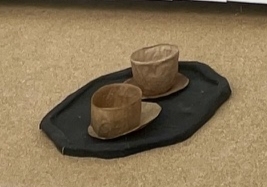
Since 2005, a collective archive has been created from used tea bags sent in by numerous citizens throughout the German-speaking world. The installation makes visible that social cohesion is not a given, but must be continually created together.
From 150 submissions, 15 artists were selected by jury for the exhibition “Zeitzeichen: Demokratie”—including myself with my installation DEMOKRATEA-TIME.
The exhibition by BBK Rheinland-Pfalz will take place from 25 September to 23 October 2026 at the State Representation of Rhineland-Palatinate in Berlin. It is dedicated to artistic positions on democracy, freedom, tolerance, social cohesion, and dealing with extremist tendencies.
Within this context, my work occupies a particular position: it understands democracy not exclusively as a political system or abstract concept, but as an everyday, material, and social practice. Democracy reveals itself here in collecting, in sharing, in listening, in repairing, and in the continual re-making of connections.
A Material Archive Grown Over Twenty Years
DEMOKRATEA-TIME emerges from materials that themselves carry a long history within my artistic practice.
At its center are strips made from used tea bag papers. Their history dates back to 2005/06. They were already part of various installations of the WELTENBÜRGERWELT (World Citizens’ World), including Kommt zu Tisch… (Come to the Table…), WELTENBÜRGERNETZ, and WELTENBÜRGERWELT – Installation for a Place of Humanity.
In 2026, these paper strips are transferred into a new spatial and societal context. They are complemented by knotted threads I created in 2009. These threads, too, are not neutral starting material. They carry their own work history into the new installation.
Thus, a time-layered work emerges: the installation is new, yet its materials have already passed through different places, constellations, and states of being. The past is not merely documented; it is materially carried forward into the present.
A Special Form of Collective Art
Since 2005, citizens throughout the German-speaking region have collected used tea bags, dried them at home, and sent them to me or brought them by in person.
From these individual actions, over more than two decades, an extensive collective material archive has emerged. Thousands of people—often over long periods—have contributed to this archive. Each submission is unassuming yet meaningful: a remnant of everyday life that is preserved, passed on, and becomes part of a shared artistic process.
This is the uniqueness of the project.
DEMOKRATEA-TIME is not the result of a short-term participatory action, nor is it a solo artwork developed exclusively by a single artist. The installation is based on a collecting movement that has grown over twenty years and is sustained by numerous citizens.
The WeltenBürgerNetz(World Citizens’ Network), which has been continuously growing since 2007, forms the social and conceptual framework of this practice. Its fundamental principle is:
Without connection, no further growth
Thus, the material of the installation carries not only my personal work history. It also carries the history of numerous people—their everyday actions, their attentiveness, and their willingness to bring something seemingly worthless into a shared context.
Repair as a Democratic Gesture
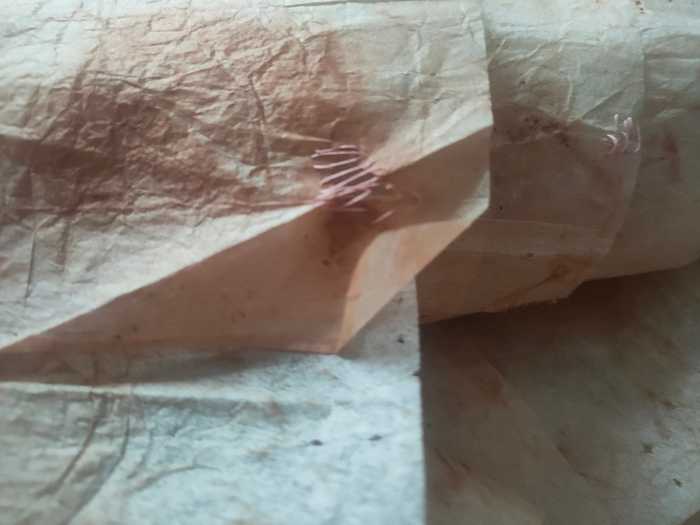
The tea bag papers show traces of their age and previous use. Some are torn, others have holes or fragile areas.
I do not sort out these damaged elements. I mend, stitch, and repair them by hand. Repair thereby becomes an essential part of the new work.
The tears remain visible. Equally visible is the care with which the vulnerable materials are treated.
This decision is also a societal statement. It raises the question of how we deal with what has become damaged, fragile, or vulnerable:
- What do we preserve?
- What do we repair?
- What is allowed to keep its history?
- How can new connections emerge from breaks?
DEMOKRATEA-TIME offers no final answer to these questions. Rather, the installation makes a process visible: the shared does not arise by making all traces of vulnerability disappear. It arises by working with breaks and continually re-establishing connections.
Democracy as Practice
In DEMOKRATEA-TIME, paper strips are connected with one another, old threads are given a new context, damaged materials are repaired, and individual elements become part of a new overall structure.
Thus, democracy is presented not only as a political theme. It appears as concrete practice:
- as care for the vulnerable,
- as dialogue between different experiences,
- as participation in a shared process,
- as willingness to take responsibility,
- as the ability to nurture and newly forge connections.
The installation translates societal questions into a material language. Paper, thread, knot, tear, and seam become carriers of political and social meaning.
A knot connects, but does not erase the separated ends. A seam holds something together without making the break invisible. A collected tea bag paper remains a remnant of everyday life and simultaneously becomes part of a collective memory.
Between Personal History and Public Space
The exhibition *“Zeitzeichen: Demokratie”* by BBK Rheinland-Pfalz creates a space for different artistic perspectives on contemporary democratic society. In a time of increasing social tensions, it becomes ever more important to make diverse experiences visible and to give space to artistic voices that question, expand, or reformulate existing narratives.
DEMOKRATEA-TIME brings into this public space a history that is both personal and collective.
The installation connects the more than twenty-year development of the WELTENBÜRGERWELT with the present of 2026. It shows how a far-reaching context can emerge from many small, everyday contributions.
The work is new.
Its materials remember.
The tears remain visible.
The repair becomes part of the work.
Thus, DEMOKRATEA-TIME becomes an artistic statement about democracy as something that is not simply given. Democracy must be continually created together, nurtured, questioned, and carried forward.
Without connection, no further growth.
Exhibition Information
“Zeitzeichen: Demokratie”
A project by BBK Rheinland-Pfalz
Artist: Renate Helene Schweizer, BBK Karlsruhe/Berlin, and 14 further artists
Work: DEMOKRATEA-TIME – Democracy as a Practice of Care, Dialogue, and Participation
Year: 2026
Location: State Representation of Rhineland-Palatinate in Berlin, In den Ministergärten 6, 10117 Berlin
Exhibition period: 25 September – 23 October 2026
Opening: Friday, 25 September 2026, 6:30 PM
Doors open from 6:00 PM
Closing: Friday, 23 October 2026
Supported by: Stiftung Rheinland-Pfalz für Kultur
More information:[https://www.bbkrlp.de/index.php](https://www.bbkrlp.de/index.php)