
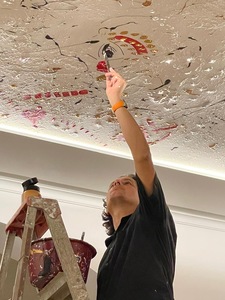
Location: Costa Rica
Architect and visual artist based in Costa Rica. Through visual elements, he seeks to explore and communicate fundamental concepts such as "CONSTRUCTION," so present in our lives and crucial to our development. Building evokes everything we accomplish, whether tangible or intangible, consciously or unconsciously, and which is a fundamental part of our results and the life we create.
Exploring the uncertainty of construct, those things you are not expected to happen. Fixing and putting together, with what you have, conscious or unconscious.
Exploring the uncertainty of construct, those things you are not expected to happen. Fixing and putting together, with what you have, conscious or unconscious.
Neighborhood evokes the chaotic and vibrant essence of the urban landscape. The composition is a whirlwind of intense colors—deep blue, fiery oranges, pinks, and purples—forming irregular structures suggestive of buildings, staircases, and anthropomorphic figures. Thin black lines delineate elements such as architectural forms, a structured celestial globe, a metallic tree against a green background resembling grass, and mechanical devices, suggesting a sense of community and movement. The hazy gray background contrasts with dominant yellows in the center, symbolizing urban vitality emerging from the gray anonymity.
Vibrant colors convey emotions and implicit narratives of chaos, thick textures add tactile depth, while scattered figurative elements invite the interpretation of the "neighborhood" as a social microcosm, where chromatic chaos reflects diversity and human dynamism without realism, capturing the collective energy of lived space.
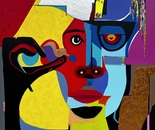
This collection, created in collaboration with artist Cynthia Rozencwaig, explores Hybrid Identity as a defining condition of contemporary human beings.
Through these paintings, the profound and ambivalent impact of the digital world on our essence is confronted: the internet, social media, performative identities—both anonymous and exposed—avatars, profiles, and virtual masks that coexist with the physical and biographical self.
In a fragmented yet hyperconnected landscape, the individual is no longer singular, but multiple: a web of overlapping, contradictory, and mutually reinforcing versions. This condition generates inevitable—and often irreversible—transformations, both personal and collective.
The series does not seek to pass moral judgment or offer harmonious solutions. Rather, it makes visible the productive tension between the positive and the destructive: the expansion of self-expression and constant surveillance, global connection and radical solitude, the liberation from traditional norms and the new tyranny of perpetual visibility.
These works portray the post-digital subject as a constantly mutating hybrid: a being that can no longer be defined without including the screen, the algorithm, and the gaze of the digital other. A being whose identity, for the first time in history, is constructed simultaneously inside and outside the body.
The question that resonates in each canvas is not “Who am I?” but “Who are we when we can no longer cease to be many?”
This piece of art seeks to explore concepts about the impact of virtual, artificial, and robotic technology on human beings and how it can turn us into hybrid beings in a world that seems surreal.
This series seeks to explore, through hybrid humanoid figures, the symbiotic relationship between humans and the cyber world and all that this implies in terms of identity, the transformation and changes that this process has generated in humanity, through things like social media profiles, avatars, emojis, and more recently through Artificial Intelligence
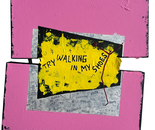
"Try Walking in My Shoes," inspired by the title of the Depeche Mode song of the same name, represents a profound expression of a father's feelings toward his son. It reflects the difficult moments in their relationship, marked by external influences and complex life circumstances, often impossible to explain in words.
The work conveys a father's anguish at his son's questioning of past decisions. However, only by walking the same path—experiencing firsthand the challenges, dilemmas, and pressures of life—can one truly understand the reasons behind those actions. Only then can those choices, which at the time seemed incomprehensible, be explained and fully understood.
This piece invites intergenerational empathy, reminding us that true understanding arises not from explanations, but from shared experience.
"Try Walking in My Shoes," inspired by the title of the Depeche Mode song of the same name, represents a profound expression of a father's feelings toward his son. It reflects the difficult moments in their relationship, marked by external influences and complex life circumstances, often impossible to explain in words.
The work conveys a father's anguish at his son's questioning of past decisions. However, only by walking the same path—experiencing firsthand the challenges, dilemmas, and pressures of life—can one truly understand the reasons behind those actions. Only then can those choices, which at the time seemed incomprehensible, be explained and fully understood.
This piece invites intergenerational empathy, reminding us that true understanding arises not from explanations, but from shared experience.
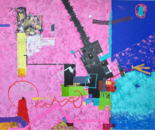
This work explores geometric forms and seeks distinct yet interconnected orders. It evokes a sense of order, but also of a seemingly controlled chaos, forming distinct sets that each have their own language, yet remain interconnected. It reminds us somewhat of the chaos and order of the physical and emotional environments in which we live, share, and develop.
This work explores geometric forms and seeks distinct yet interconnected orders. It evokes a sense of order, but also of a seemingly controlled chaos, forming distinct sets that each have their own language, yet remain interconnected. It reminds us somewhat of the chaos and order of the physical and emotional environments in which we live, share, and develop.

 “UNEXPECTED BLUE”
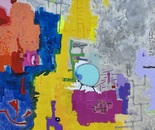 “VECINDARIO”
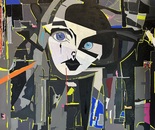 “PLEASURE AND PAIN”
 “HYBRID IDENTITY I”
 ““TRY WALKING IN MY SHOES””
 “UNTITLED”